Most founders in Dubai pick a business structure based on one number: the setup cost. That single habit causes the most expensive mistakes we see. If the choice is close, business setup consultants can model both for you.
A sole establishment looks cheaper on day one. An LLC costs more upfront. So people choose the sole establishment, save a few thousand dirhams, and move on. Then the business grows. A partner wants to join. A corporate client asks for a contract a sole establishment cannot sign. A bank stalls on the account. The only fix left is to close the first licence and build a new company from scratch. Your structure also affects how easily you open a corporate bank account.
This guide compares a sole proprietorship and an LLC in Dubai the way a setup consultant actually weighs them: liability, banking, ownership, tax, and the cost of changing your mind later. Best Solution has handled more than 5,000 company formations in the UAE since 2014, so the examples below come from real client files, not theory.
| If This Is You... | Best Fit | Why |
|---|---|---|
| Solo consultant or freelancer, low risk, no partners | Sole establishment | Lower cost, fast setup, full control |
| Trading, retail or import-export | LLC (mainland) | Sole establishments cannot trade goods |
| Plan to take partners or investors | LLC | Sole establishments allow one owner only |
| Selling to corporates or need strong banking | LLC | Separate legal entity; more credibility |
| Serving overseas / online clients | Free zone LLC (FZE/FZCO) | 0% tax on qualifying income; no LSA |
Sole proprietorship vs LLC in Dubai: the quick answer
A sole proprietorship (called a sole establishment in the UAE) is owned by one person who carries unlimited personal liability. An LLC is a separate legal entity that limits your liability to what you invest. Choose a sole establishment for low-risk solo work. Choose an LLC if you will scale, take on partners, or sign corporate contracts.
Both structures pay the same 9% UAE corporate tax on profits above AED 375,000, and both can sponsor employee visas. The real split is about risk, ownership, and how easily you can grow.
What is a sole proprietorship (sole establishment) in Dubai?
A sole establishment is a business owned and run by one individual. There is no legal line between the owner and the business. You trade under your own name or an approved trade name, and you keep all the profit after tax. Both forms begin with trade name registration before licensing.
It is licensed mainly for professional and service activities: consultants, freelancers, designers, IT specialists, doctors, engineers, lawyers and accountants. Foreign owners cannot trade goods or manufacture under this structure; those activities need an LLC.
For an expatriate owner on the mainland, a sole establishment needs a Local Service Agent (LSA). The LSA is a UAE national who handles government paperwork only. They hold no shares and no control over the business (more on the real LSA facts below).
Key traits at a glance:
- Single owner with 100% of the profit and full control
- Unlimited personal liability — your house, car and savings can be reached for business debts
- Professional or service licence, issued under your name or trade name
- No Memorandum of Association (MOA); simpler, faster paperwork
- LSA required for expat owners; UAE and GCC nationals do not need one
What is an LLC (Limited Liability Company) in Dubai?
An LLC is a company that exists as a separate legal entity from its owners. The business owns its debts and risks, not you. Your liability is limited to the share capital you put in, so your personal assets stay protected from company debts and lawsuits.
An LLC can have 1 to 50 shareholders. A single-owner LLC is allowed and is called a One Person Company (OPC). It must carry "LLC (OPC)" in the trade name, and it gives the same limited-liability protection as a multi-owner LLC.
Setting one up needs a notarised Memorandum of Association (MOA) and at least one appointed manager. Mainland LLCs are licensed by the Dubai Department of Economy and Tourism (DET); free-zone LLCs are licensed by their own free-zone authority. Since the June 2021 foreign-investment reforms, 100% foreign ownership is allowed for most commercial and industrial activities on the mainland, with no UAE national partner required.
Why founders choose it:
- Limited liability — personal assets are separated from the business
- 100% foreign ownership for most mainland activities
- Wider activity scope: commercial, industrial and professional
- More credibility with banks, suppliers and corporate clients
- Perpetual succession — the company survives ownership changes
- Easier to add partners, raise capital and sponsor more visas

Ready to Launch Your Business in Dubai?
Don't let structure mistakes delay your banking or cost you thousands in restructuring fees later. Drop your details , and a Best Solution specialist will reach out within 24 hours to map your optimal path.
Sole proprietorship vs LLC in Dubai: side-by-side comparison
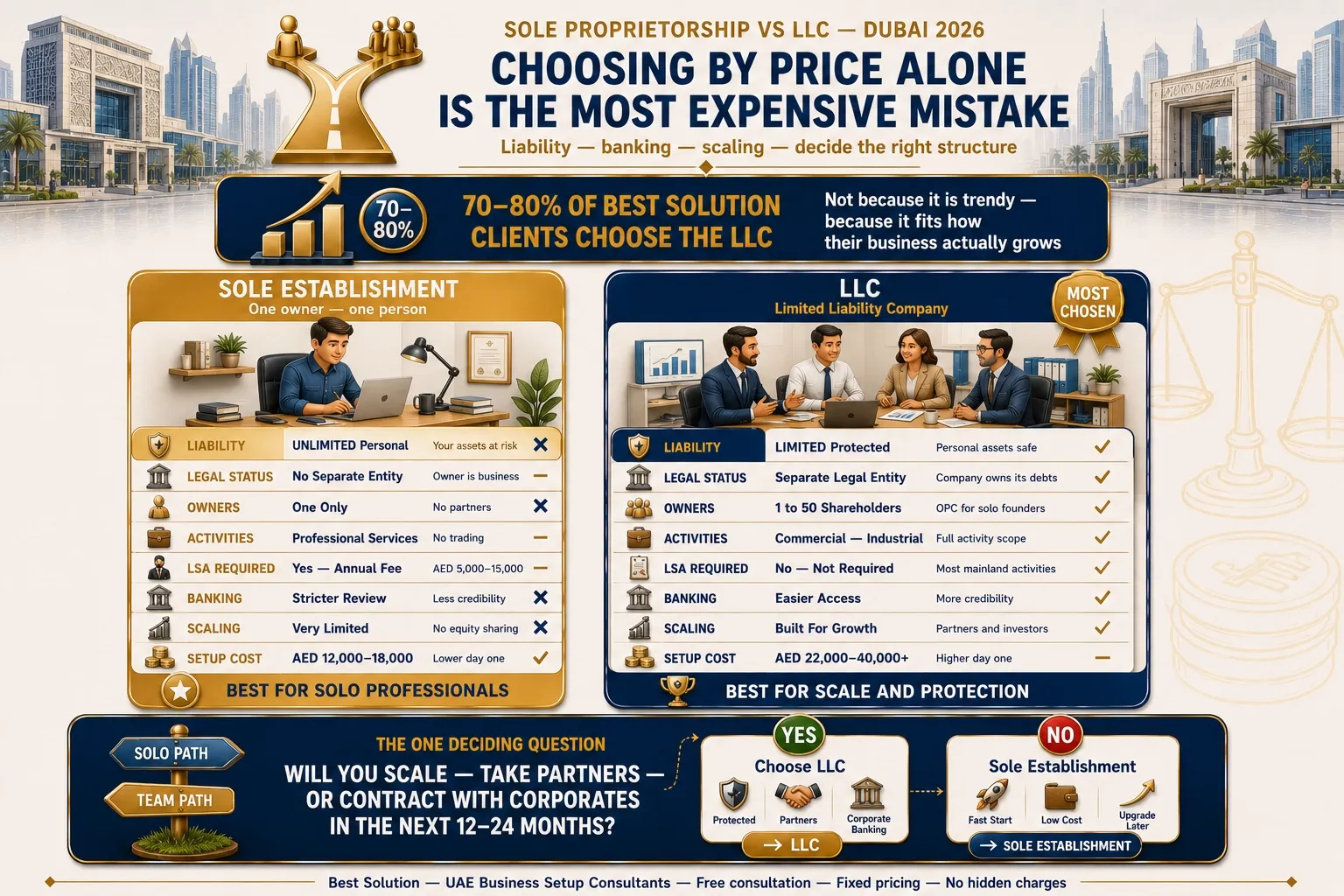
Here is how the two structures compare on the points that change your decision:
| Feature | Sole Proprietorship | LLC |
|---|---|---|
| Legal status | No separate entity — owner and business are one | Separate legal entity |
| Liability | Unlimited personal liability | Limited to share capital |
| Owners | One individual only | 1 to 50 shareholders (OPC for solo) |
| Activities | Professional / services only (for expats) | Commercial, industrial and professional |
| Foreign ownership | 100% with an LSA (professional licence) | 100% for most mainland activities |
| Local requirement | Local Service Agent (no equity) | No sponsor for most activities |
| Corporate tax | 9% on profit above AED 375,000 | 9% on profit above AED 375,000 |
| VAT | 5% if turnover exceeds AED 375,000 | 5% if turnover exceeds AED 375,000 |
| Banking | Possible, but stricter review | Easier corporate banking access |
| Scaling / investors | Hard — single owner, no shares | Built for partners and investment |
| Continuity | Ends if the owner exits or passes away | Continues; shares can transfer |
What is the real difference in liability?
Liability is where structure stops being paperwork and starts affecting your bank balance. With a sole establishment, the business and the owner are the same in law. If the business owes money or is sued, the claim can reach your personal assets. With an LLC, exposure is capped at what you invested in the company.
A real Best Solution case shows why this matters.
Client case: when unlimited liability got real
A consultant set up as a sole establishment offering management and business advisory services. The setup was simple and cheap, which suited a solo start. As the firm grew, the work changed: long-term service contracts, subcontracted specialists, and performance-based deliverables with larger obligations. A client then disputed delivery against the service agreement and sought compensation for alleged losses. Because the business was a sole establishment, owner and company were legally one, so the exposure could extend to personal assets. The matter was resolved without litigation. But the risk was real enough that the owner restructured into a mainland LLC, gaining limited liability, stronger credibility with corporate clients, and an easier path to hire and expand. Lesson: many consultants start as sole establishments for the low cost. Once contracts get bigger, an LLC usually fits the risk better.
What does each structure actually cost in 2026?
Competitor guides often quote an LLC at AED 19,500-30,000 and a sole establishment near AED 18,500, which makes the gap look small. In practice the spread is wider, and the headline price is rarely the full price.
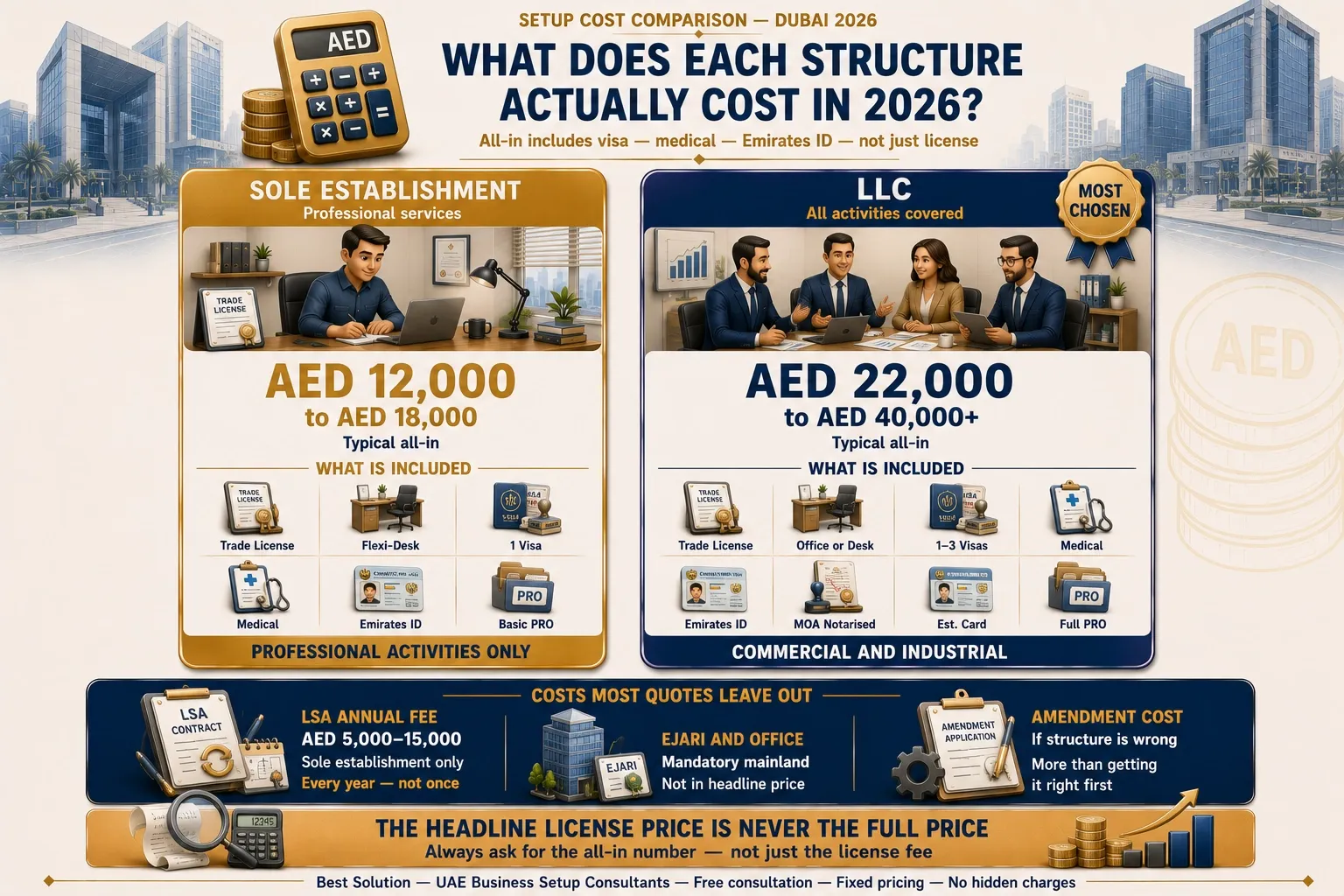
Observed 2026 ranges from Best Solution client files:
| Structure | Typical Setup (Mainland) | Notes |
|---|---|---|
| Sole establishment | AED 12,000 - 18,000 | Lower entry cost; professional activities |
| LLC | AED 22,000 - 40,000+ | Varies by activity, visas and office |
The costs people forget are usually the ones that decide the budget:
- Local Service Agent fee — an annual cost for expat sole establishments, often left out of headline pricing
- Ejari and office tenancy — mandatory for most mainland licences
- PRO and immigration — visa processing, establishment card, labour file setup
- Bank account preparation — business profile and compliance documents
- Amendment or re-registration — if the first structure was wrong, fixing it costs more than getting it right
For a fuller picture, see our breakdown of the cost of starting a business in Dubai. Best Solution quotes fixed pricing so these line items are visible before you commit, not after. Either way, the setup steps follow our guide on how to start a business in Dubai.
The hidden cost nobody quotes: restructuring later
This is the cost most comparisons ignore, and it is the one that catches founders out. A sole establishment cannot take equity partners or shared ownership. So the common pattern looks like this:
- You start as a sole establishment to keep day-one costs low.
- The business grows. You want a partner, a bigger contract, or stronger banking.
- A sole establishment cannot accommodate any of those, so it has to be dissolved.
- You form a new LLC and migrate operations, contracts and staff across.
The bill is not just the new LLC fee. It is administrative downtime of roughly one to three weeks, plus the effort of moving contracts and clients to the new entity. Choosing the cheaper structure first can cost more in total than choosing the right one once.
Across recent commercial setups, roughly 70-80% choose an LLC and 15-25% choose a sole establishment or freelance permit, with a small remainder in special cases such as civil companies and branches.
By client type: freelancers and solo professionals lean to sole establishments for cost and simplicity; traders and import-export businesses strongly prefer LLCs for banking and supplier credibility; agencies and service companies mostly pick LLCs to scale, hire and contract.
Based on 5,000+ formations since 2014.
Do sole proprietors need a 51% local sponsor in Dubai?
No. This is one of the most common pieces of outdated advice online, and some ranking pages still repeat it. A sole establishment for an expat does not need a 51% local partner. It needs a Local Service Agent (LSA), which is a very different role.
What an LSA actually is:
- A UAE national appointed to represent a mainland sole establishment for licensing only
- Holds no shares and takes no profit
- Has no operational control over the business
- Is paid a fixed annual fee, typically AED 5,000-15,000 depending on the agreement and activity
The old 51% sponsor model applied to mainland LLCs before the June 2021 reforms, and even that is gone for most activities now. Do not pick or rule out a sole establishment based on a sponsorship rule that no longer applies.
Which structure is right for you?
After thousands of these conversations, the decision usually comes down to one question:
The deciding question
"Will you bring in partners, scale the business, or contract with corporate clients within the next 12-24 months?" If yes: an LLC is almost always the right structure. If no: a sole establishment or freelance setup may be enough for now.
Choose an LLC if:
- You plan to take partners, raise capital, or sell equity
- You trade goods, run retail, or carry real operational risk
- You sell to corporates or need strong corporate banking
- You want the business to outlive any single owner
Choose a sole establishment if:
- You are a solo professional in a low-risk field
- You do not need outside investment or partners
- You want the fastest, lowest-cost way to start and test the market
The hesitation we hear most is "I want to keep costs low now" and "can I upgrade later?" You can always upgrade later. But restructuring later usually costs more than setting it up correctly from the start. That trade-off is the real decision point.
Still weighing it up? Our guide to the legal types of business in the UAE maps every option, and LLC company formation in Dubai walks through the LLC route step by step. Your structure shapes the business visa options open to owners.
What about free zones?
Free zones do not issue sole establishment licences. If you want a single-owner setup with liability protection, the free-zone answer is a Free Zone Establishment (FZE) or Free Zone Company (FZCO). These give you one-owner control plus limited liability, which a mainland sole establishment cannot.
Free-zone LLCs also offer 0% corporate tax on qualifying income and no Local Service Agent, which suits businesses serving overseas or online clients. They cannot trade directly in the UAE mainland market, though. If your customers are mostly in the UAE, a mainland licence fits better. Our free zone vs mainland in Dubai comparison covers the trade-offs in full. A sole establishment may still need a local service agent for some activities.
One 2026 note for either route: the UAE is rolling out mandatory e-invoicing for B2B and B2G transactions from July 2026, so build compliant accounting in from the start. Both structures register and file under the Federal Tax Authority rules.
Choose the right structure with Best Solution
Picking between a sole establishment and an LLC is one of the first real decisions of your Dubai business, and the one that quietly shapes your liability, banking and growth. Get it right once and you avoid the restructuring bill later.
Best Solution has supported 5,000+ company formations and 4,500+ banking applications in the UAE since 2014, across trading, consulting, agencies and regulated activities, on both the mainland and in free zones. We quote fixed pricing, flag the hidden costs up front, and recommend the structure that fits where your business is heading, not just where it starts.
Talk to a Best Solution consultant for a structure recommendation tailored to your activity, budget and growth plans, or start with how to start a business in Dubai.