Most guides on how to start a business in Dubai sell you a number. "Set up from AED 12,000." "Licence in 48 hours." The cheapest package wins the click, so the founder picks it. Early on, get familiar with the business licence essentials every company needs. If you deal in goods, a general trading company is a common route. For onshore trade, forming an LLC is the most common structure.
Then year two arrives. The business needs a mainland trade licence to sign a government contract. Or the bank wants a clearer activity code before it will approve the account. The low-cost setup has to be unwound and rebuilt, and the early saving is gone.
Here is a more useful way to think about it. A business licence is not a product you buy at the lowest price. It is the legal foundation your company runs on. Choose it for where the business is going, not just for what it costs on day one.
This guide covers the full process of starting a business in Dubai in 2026: choosing between mainland and free zone, picking the right activity and licence, the real costs, documents, visas, banking, and tax. It draws on what Best Solution has learned forming more than 5,000 companies in the UAE since 2003. For the widest local access, many founders register a Dubai mainland company. Once trading, you can sponsor staff through the available business visa options. Many first-timers begin by setting up in a free zone for full ownership and a faster launch. Once registered, you can arrange visas for entrepreneurs and employees.
Dubai rewards getting this right. The emirate's GDP grew 4.7% in the first nine months of 2025 to reach AED 355 billion, and the UAE registered roughly 250,000 new companies in 2025 alone. The demand is real. The work is setting up correctly the first time.
| Step | What it involves |
| 1. Choose business activity | Pick from 2,000+ DED-approved activities; match it to your real revenue plan. |
| 2. Pick a jurisdiction | Mainland, free zone, or offshore, based on who you sell to and how you will grow. |
| 3. Select a legal structure | LLC, sole proprietorship, civil company, branch, or free zone company. |
| 4. Reserve a trade name | Unique, activity-relevant, compliant. Held for six months once approved. |
| 5. Get initial approval | The authority confirms there is no objection to your business. |
| 6. Secure office + trade licence | Flexi-desk or office, then the trade licence is issued. |
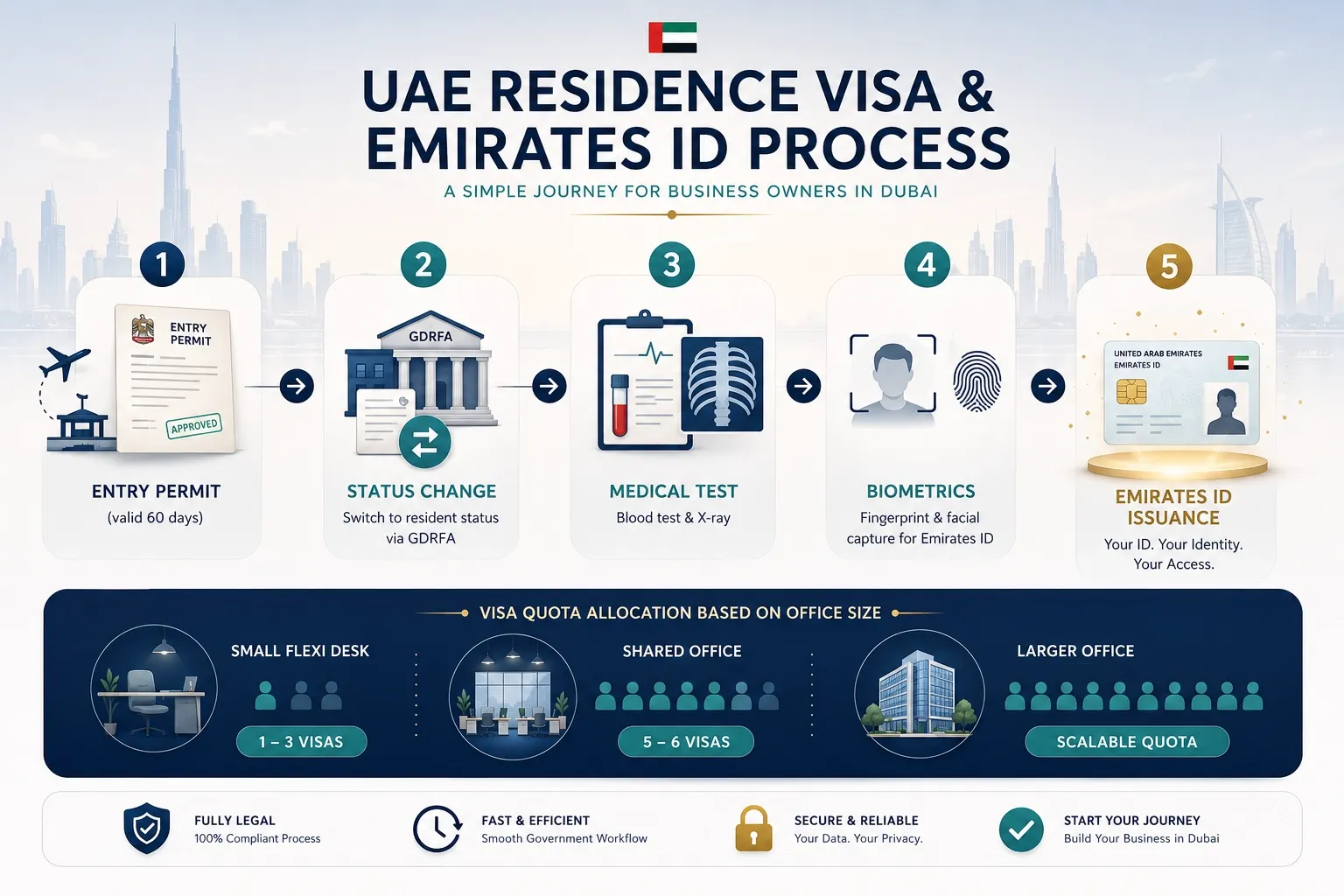
| 7. Apply for residence visas | Entry permit, medical test, biometrics, and Emirates ID. |
| 8. Open bank account + register for tax | Corporate account setup followed by VAT and corporate tax registration. |
How do you start a business in Dubai?
To start a business in Dubai, choose your business activity, pick a jurisdiction (mainland or free zone), and select a legal structure. Reserve a trade name and apply for initial approval. Then secure office space, collect your trade licence, apply for residence visas, open a corporate bank account, and register for tax. Some activities need extra permits — opening a restaurant is a good example. Even niche ideas like a pet care business follow the same core steps.
That is the sequence. The order matters, because each step unlocks the next. You cannot apply for a licence before your activity is confirmed, and you cannot open a bank account before the licence is issued. The rest of this guide explains each step, what it costs, and where founders most often go wrong.
Why start a business in Dubai in 2026?
Dubai's appeal is not a slogan. It shows up in the numbers.
The emirate's economy grew 4.7% in the first nine months of 2025, with GDP reaching AED 355 billion. Growth in the third quarter alone hit 5.3%. The fastest-moving sectors were healthcare and social work (up 15.4%), financial and insurance activities (up 8.5%), and construction (up 8.5%). This is a diversified, non-oil economy, which means demand is spread across many industries rather than concentrated in one.
Company formation reflects that. The UAE registered around 250,000 new companies in 2025, bringing the total past 1.4 million. Free zones accounted for roughly 41% of new registrations.
For a new business, four advantages stand out:
- 100% foreign ownership. Since the Commercial Companies Law reform, foreign investors can fully own a mainland company in more than 1,000 business activities. Free zones have always allowed full ownership.
- A light tax regime. There is no personal income tax. Corporate tax is 9%, and it applies only to profits above AED 375,000.
- Global reach. Dubai sits between Europe, Asia, and Africa, with two of the world's busiest cargo gateways at Jebel Ali Port and Dubai International Airport.
- A real support ecosystem. Accelerators, free zone incubators, and funding programmes back early-stage founders, especially in technology and trade.
None of this removes the need to plan. It just means a well-structured business has room to grow.
Mainland, free zone, or offshore: which should you choose?
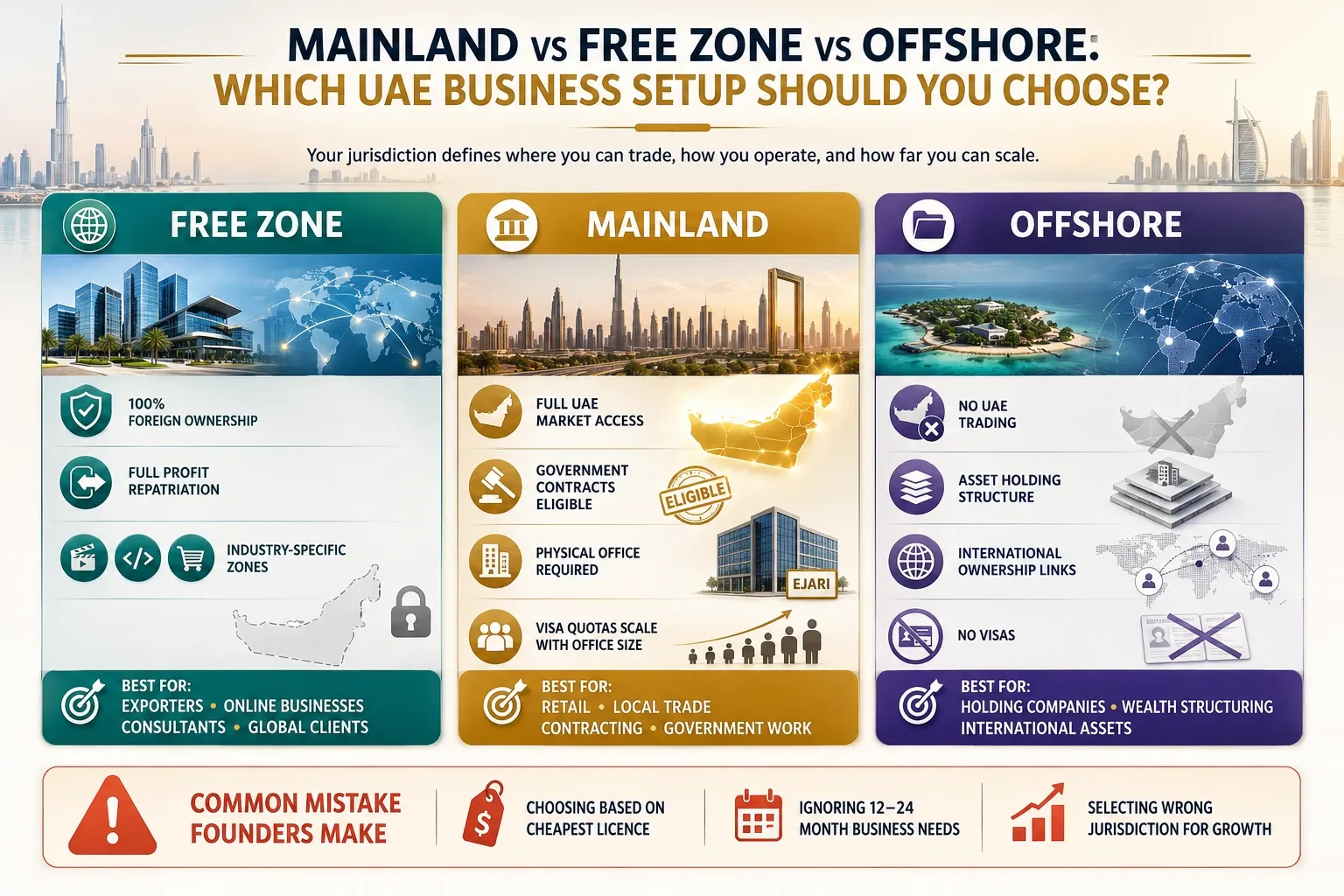
This is the first major decision, and it shapes everything after it. Your jurisdiction sets who you can sell to, how much you pay, and how much you can expand later.
Free zone company
A free zone is a designated economic area built to attract foreign investment. Dubai has more than 30 of them, and many are organised around an industry, such as media, technology, or commodities.
A free zone company gives you 100% foreign ownership with no UAE national sponsor, full repatriation of capital and profits, and a fast, bundled setup. The trade-off: a free zone company cannot sell directly into the UAE mainland market without a local distributor or a separate permit. It is the strong choice for exporters, online businesses, consultancies, and founders serving international clients.
Mainland company
A mainland company is registered with the Dubai Department of Economy and Tourism (DET), and the UAE Government publishes the official mainland setup steps. A mainland company can trade anywhere in the UAE, open branches freely, and bid for government contracts, which free zone companies cannot do.
Most mainland activities now allow 100% foreign ownership, though a few strategic sectors still require an Emirati partner or agent. Mainland setups usually cost more, because a physical office and an Ejari tenancy contract are mandatory. Choose mainland if you need to serve the local UAE market, run retail or contracting, or want an unrestricted visa quota.
Offshore company
An offshore company is registered in the UAE but operates outside it. It is used for holding assets, owning shares, international trading, and wealth structuring. It cannot trade inside the UAE and does not grant residence visas. Treat it as a structuring tool, not an operating business.
| Factor | Mainland | Free Zone | Offshore |
| Foreign ownership | 100% in 1,000+ activities | 100%, always | 100% |
| UAE market access | Full, direct | Via distributor or permit | None |
| Government contracts | Eligible | Conditional | Not eligible |
| Office requirement | Physical office + Ejari, mandatory | Flexi-desk accepted | None |
| Residence visas | Yes, quota by office size | Yes, quota by package | No |
| Typical cost | Higher | Lower, often bundled | Low |
| Best for | Local trade, retail, contracting, government work | Exporters, online business, consultancies, global clients | Holding assets, international trade, structuring |
A word of warning from experience. The most common, and most expensive, mistake founders make is choosing a jurisdiction or activity for its day-one price rather than its long-term fit. A cheap free zone licence looks smart until the business needs to do something the licence does not allow. Decide what the business will actually need in 12 to 24 months, then pick the structure that supports it.
Choose your business activity and legal structure
Two decisions sit inside this step, and both have consequences.
Picking the right business activity
Your business activity is the operation your company is legally allowed to perform. Dubai's Department of Economic Development lists more than 2,000 approved activities, each with its own code. Free zones keep their own activity lists, usually tied to the industries they serve.
Pick the activity that matches what the business will really do. Founders often choose a broad "General Trading" activity to keep options open. It sounds flexible. In practice, a vague activity can later cause a bank to question the account, because the activity does not clearly explain how the company earns money. Align your activity with your real 12-month revenue plan, not a hypothetical one.
If your activity is regulated, such as legal consultancy, healthcare, or financial services, you will need approval from an external authority before the licence is issued. Build that into your timeline.
The legal structures available
Your legal structure decides ownership, liability, and how profits are handled. The main options are:
- Sole proprietorship. Owned by one person who carries unlimited personal liability. Foreign nationals can use it for professional services.
- Limited Liability Company (LLC). The standard mainland choice for trading and commercial activities. It has 2 to 50 shareholders, each liable only up to their capital. Foreign owners can hold up to 100% in most sectors. If you are weighing this against running solo, compare a sole proprietorship and an LLC before you decide.
- Civil company. For recognised professionals such as doctors, engineers, and consultants. Allows full foreign ownership with a UAE service agent.
- Branch of a foreign company. Lets an overseas company operate in Dubai under its parent's identity, with 100% foreign ownership and a local service agent.
- Free zone company. Set up inside a free zone with full foreign ownership and no sponsor.
Choosing a trade name happens here too. The name must reflect your activity, avoid offensive or religious terms, and stay unique. If you use a personal name, use the full name. Mainland licences usually need an Arabic version of the name. Once approved, the name is reserved for six months.

Start your UAE company with clarity and confidence.
Get a clear breakdown of your ideal jurisdiction, licence, and total setup cost before you commit.
Which business licence do you need?
Dubai issues six main licence types. Your business activity decides which one applies. Your first big decision is choosing among the types of business structures.
- Commercial licence. For trading: import and export, wholesale, retail, and logistics.
- Professional licence. For service businesses based on expertise, such as consultancy, IT, design, and education. It allows 100% foreign ownership.
- Industrial licence. For manufacturing and processing goods.
- Tourism licence. For travel, hospitality, and leisure businesses, regulated by Dubai's tourism authority.
- Agricultural licence. For farming, cultivation, and agri-tech.
- Crafts licence. For skilled trades such as carpentry, printing, and metalwork.
A commercial licence is flexible. You can list several related activities under one licence, which helps a growing business. Match the licence to the activity exactly. Operating outside your licensed scope can lead to fines or suspension.
How much does it cost to start a business in Dubai?
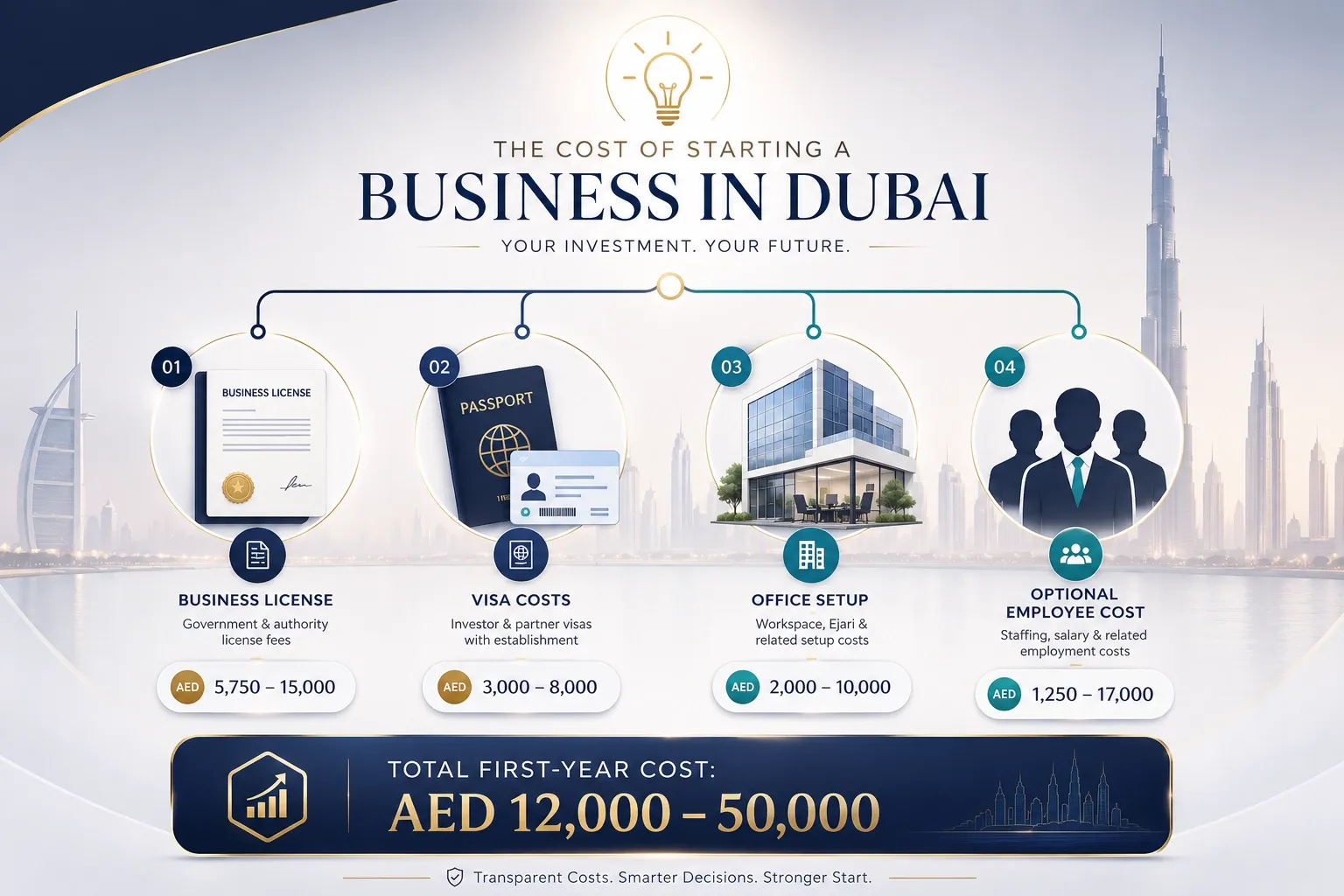
Cost is the question every founder asks first, so here is a straight answer. Starting a business in Dubai usually costs between AED 12,000 and AED 50,000, depending on jurisdiction, activity, visas, and office needs. A lean free zone setup often lands near AED 25,000. To skip the guesswork, business setup consultants can run the process for you.
The total comes from a few moving parts.
Licence and registration fees
A professional or commercial licence in a free zone typically costs AED 10,000 to AED 20,000 a year. A mainland licence from the DET usually starts around AED 15,000 and can pass AED 40,000 once extra activities and external approvals are added. Registration fees add roughly AED 5,000 to AED 10,000.
Visa and office costs
An investor visa costs about AED 3,500 to AED 7,500, including the medical test, Emirates ID, and stamping. Employee visas run AED 4,000 to AED 6,000 each. Free zones let you start with a flexi-desk from around AED 8,000 a year. A mainland office is mandatory and usually starts near AED 30,000 a year.
A realistic first-year budget
Many free zones bundle the licence, registration, and a shared desk into a single package starting near AED 12,000. That is a real entry point. But read the contract. A no-visa package will not let you sponsor yourself, and a sector-restricted zone may block an activity you need next year. For a deeper breakdown, see the real cost of starting a business in Dubai. Regulated sectors add steps; a real estate company needs RERA approval.
Here is the honest version of the cost question. The cheapest package is not the cheapest outcome. Founders who pick the lowest sticker price often pay again later to upgrade, change jurisdiction, or correct an activity. Every structure has a fair market value. Budget for the setup the business actually needs, and treat a suspiciously low price as a prompt to ask what is missing.
| Cost item | Typical range (AED) |
| Free zone licence (professional or commercial) | 10,000 - 20,000 / year |
| Mainland licence (DET) | 15,000 - 40,000+ / year |
| Registration fees | 5,000 - 10,000 |
| Investor visa (incl. medical, Emirates ID) | 3,500 - 7,500 |
| Employee visa (per person) | 4,000 - 6,000 |
| Free zone flexi-desk | from 8,000 / year |
| Mainland office | from 30,000 / year |
| Bundled free zone package | from 12,000 |
| Typical total first-year setup | 12,000 - 50,000 |
Registering your company: documents and approvals
Once your activity, structure, and licence type are set, registration is mainly a documentation exercise. Get the paperwork right and it moves quickly.
Documents you need
For most setups you will provide:
- Passport copies for all shareholders and directors, valid for at least six months
- Passport-size photographs
- Emirates ID and visa copies, if any shareholder is a UAE resident
- Proof of address
- A No Objection Certificate (NOC), if a shareholder is a UAE resident employed elsewhere
- The Memorandum of Association (MoA), notarised for mainland companies
- An office lease or flexi-desk agreement
You will also confirm the company activity, three trade name options, the share split between shareholders, and how many visas you need.
The approval timeline and common rejection reasons
After you submit, expect one to two working days for the authority to review and either approve or reject the application. Initial approval is the green light to continue. The trade name is held for six months, so finish registration inside that window.
Applications are usually rejected for incomplete or incorrectly formatted documents, an activity that does not match the business, unresolved visa issues such as overstays, or a weak compliance history. A clean, consistent file is the fastest file.
Getting your UAE residence visa and Emirates ID
Once your licence is issued, you can sponsor your own UAE residence visa, and then visas for staff and family.
The process starts with an entry permit, valid for 60 days. Inside the country, you change your status to resident. Mainland companies file through the General Directorate of Residency and Foreigners Affairs (GDRFA). Free zone companies usually handle immigration through the zone authority, which is often faster.
Three steps complete it: a medical fitness test (a blood test and chest X-ray, with results in 24 to 48 hours), biometric capture for the Emirates ID, and issuance of the Emirates ID itself, normally within 7 to 10 working days.
Your visa quota is tied to your office. A flexi-desk usually allows 1 to 3 visas, a shared office around 5 to 6, and a dedicated office is calculated by size, with a common benchmark of one visa per 9 square metres. Plan your space around the headcount you expect.
Opening a corporate bank account in Dubai
For most foreign founders, the bank account is the most sensitive step. It is also the one that rewards preparation.
UAE banks run strict Know Your Customer (KYC) checks, required by the UAE Central Bank. They want to see a clear, legitimate business: who owns it, how it earns money, and what transactions to expect. Local banks such as Emirates NBD, First Abu Dhabi Bank, and Mashreq suit day-to-day UAE operations. International banks such as HSBC and Standard Chartered suit cross-border businesses.
Expect to provide passport copies, residence visas and Emirates IDs, the trade licence, the MoA, the office lease, and a business plan or cash-flow projection for a new company. Approval usually takes 5 to 25 business days.
Two things speed it up. First, describe the business model precisely. A vague activity is the most common cause of delay. Second, choose a bank that actually accepts your business type and stage, rather than applying everywhere at once.
Tax, VAT, and staying compliant
Dubai's tax environment is light, but it is no longer zero. Compliance is now part of running a company here.
Corporate tax and the Qualifying Free Zone Person rule
The UAE introduced a 9% federal corporate tax for financial years starting on or after 1 June 2023. It applies only to taxable profits above AED 375,000. Profits below that threshold are taxed at 0%, which protects small businesses and startups. The Federal Tax Authority administers it.
Free zones are often described as tax-free. The reality is more precise. A free zone company can keep a 0% rate only if it qualifies as a Qualifying Free Zone Person (QFZP), which means meeting conditions on the type of income it earns and how much non-qualifying income it has. Cross those limits and the 9% rate applies. If a free zone is part of your plan, confirm your QFZP position early rather than assuming the 0% rate is automatic.
VAT registration
VAT is 5%. Registration with the Federal Tax Authority is mandatory once annual taxable supplies exceed AED 375,000, and voluntary between AED 187,500 and AED 375,000. Once registered, you issue compliant invoices, keep clean records, and file returns on schedule. Penalties for errors start at AED 10,000, so set up accounting from day one. Our tax registration in Dubai covers the process in detail.
Hiring and labour law basics
If you hire staff, UAE labour law applies under Federal Decree-Law No. 33 of 2021. Contracts are fixed-term, employees get at least 30 days of paid annual leave a year, and non-national staff earn an end-of-service gratuity after one year. Mainland employers register staff with the Ministry of Human Resources and Emiratisation (MOHRE) and pay salaries through the Wage Protection System.
How Best Solution helps you start the right way
Best Solution has formed business setups in Dubai since 2003, when Essa Al Harthi started the company as a small venture. It now operates from Business Bay with a team of more than 50 specialists, and has formed over 5,000 companies across the UAE.
That scale matters because of one thing: jurisdiction fit. As a channel partner with Meydan Free Zone, DMCC, IFZA, DIFC, Dubai South, Sharjah Media City (SHAMS), SPC Free Zone, RAKEZ, RAK ICC, Dubai Internet City, and others, plus full mainland licensing through the DET, Best Solution can match a founder to the right structure rather than the one zone it happens to sell.
Speed follows from getting the structure right. When Swiss entrepreneur Kristian Khachatourian set up Clear View Group, Best Solution delivered the licence in two working days. For Cyprus-based founder Roman Starikovich, who launched STARWAY Group as a mainland company in real estate, tourism, and corporate services, the licence was released in two days, the setup cost came in around 20% below prevailing market rates, and the business has since secured one investor visa and more than 20 employee visas as it grew. Best Solution also managed the formation of an investment company for Roy C J, Chairman of the Confident Group, working with him directly throughout.
The pattern across those cases is not a discount. It is a setup built around what the business needed next, so it did not have to be rebuilt later.
Start with the structure, not the sticker price
Starting a business in Dubai is not complicated when the steps run in the right order: activity, jurisdiction, structure, name, approval, licence, visa, bank account, tax. The mistake that costs the most is not a missed step. It is choosing the cheapest option instead of the right one.
Decide what your business will need in two years, then build the setup to match. If you want that decision checked before you commit, Best Solution offers a free consultation that maps your activity, jurisdiction, and licence to your actual plan, with hands-on support through every step.
Browsing options first? See our guide to profitable business ideas in Dubai to pressure-test your concept before you register.
Before You Register
Unsure which structure fits? A short consultation maps your activity, jurisdiction, and licence before you commit money.