Most free zone owners do not go looking for this permit. A mainland client asks for a local invoice. Or recurring UAE revenue starts landing in the account. Or a tender opens that was always off-limits. Suddenly the existing free zone licence does not cover how the business already operates. The Free Zone Mainland Operating Permit, introduced under Dubai Executive Council Resolution No. (11) of 2025, is usually discovered as the answer to that problem, not as a plan made in advance.
This guide explains what the permit actually allows, the three legal routes a Dubai free zone company can use to work on the mainland, what the permit really costs in the first year, and the corporate tax exposure that most coverage skips. The aim is simple: help you decide which route fits your revenue, not just describe a government announcement.
The permit at a glance
| Question | Short answer |
|---|---|
| What it is | A DET-issued authorisation letting a Dubai free zone company trade on the mainland without forming a separate mainland company. |
| Legal basis | Dubai Executive Council Resolution No. (11) of 2025, effective 3 March 2025. |
| Cost (temporary permit) | AED 5,000 for six months, renewable at the same fee. |
| Cost (dual licence branch) | AED 10,000 per year, renewable annually. |
| Realistic first-year all-in | AED 7,000 to AED 15,000+ once advisory, accounting and tax review are included. |
| Corporate tax | 9% on mainland-sourced profit; can affect free zone 0% (QFZP) status. |
| Who it excludes | DIFC-licensed financial institutions and, for now, regulated activities. |
What is the Free Zone Mainland Operating Permit?
The Free Zone Mainland Operating Permit is an authorisation from Dubai's Department of Economy and Tourism (DET). It lets an eligible free zone company carry out specific, non-regulated activities in mainland Dubai. You do not set up a separate onshore entity or appoint a local sponsor. It is valid for up to six months, costs AED 5,000, and is renewable. It expands where a company can legally operate; it does not convert a free zone company into a mainland one.
The permit sits inside a wider framework. The Department of Economy and Tourism and the Dubai Business Registration and Licensing Corporation (DBLC) run it with the Dubai Free Zone Council. Applications go through the Dubai Unified Licence (DUL) and the Invest in Dubai (IID) platform. DET projects that more than 10,000 free zone companies could use the new access, with cross-jurisdiction business activity rising 15 to 20 percent. The reform is part of the Dubai Economic Agenda (D33), which aims to double the size of Dubai's economy by 2033.
Three legal ways a free zone company can work on Dubai's mainland
This is where most articles blur the picture. Resolution No. (11) of 2025 did not create one option. It created three, and choosing the wrong one is the most expensive mistake at this stage. According to KPMG and law firms briefing on the resolution, DET can issue any of the following.
1. Temporary permit (up to 6 months, AED 5,000)
The lightest route. It lets a company perform approved activities on the mainland for up to six months. The fee is AED 5,000, and you can renew it. The company keeps its free zone office and 100% foreign ownership. Best for testing mainland demand, a one-off project, or a single contract, where committing to a full structure would be premature.
2. Dual licence branch (1 year, AED 10,000)
With the dual licence branch, the headquarters stays in the free zone. The entity itself is licensed to operate onshore. It runs for one year, renews annually, and the official issue or renewal fee is AED 10,000. This is the better buy once mainland revenue is recurring, several mainland clients are expected, or staff will work onshore regularly.
3. Full mainland branch or LLC
Establishing a branch or a mainland licence onshore in Dubai, with its own premises and the broadest activity scope. This is the right answer when the mainland is becoming the core of the business, not an extension of it. It costs more and takes longer, but it removes the ceiling the permit and dual licence still impose.
One limit that catches people out
None of these three authorisations works outside Dubai. A Dubai permit does not let you operate in Abu Dhabi, Sharjah, or any other emirate. Each emirate runs its own dual licence or branch system, with its own fees and authority. To trade across emirates, you need a separate arrangement in each one.
Which business activities qualify for the permit?
DET published its approved activity list, confirming which activities can run under a temporary permit and which need a branch licence. In the first phase the permit covers non-regulated activities, broadly:
- Information technology, software, and digital services
- Management, design, and professional consultancy
- Marketing and advertising
- E-commerce and logistics
- General trading and import/export
Regulated sectors such as finance, healthcare, education, real estate, and energy are expected in later phases, subject to the relevant regulator. DIFC-licensed financial institutions are excluded from the framework entirely.
A practitioner warning on activity codes. Best Solution's consultants flag that the bigger problem is rarely the code itself but activity alignment. Authorities now check that several things describe the same business: the free zone licence activity, the mainland permit activity, the website, the business model, and the client contracts. We have seen companies apply using a code that technically exists but does not match how they work. That raises questions later, during banking reviews, VAT registration, and corporate tax assessment. On the IID portal, select the exact activity that matches the original free zone licence certificate, not a generic term.

Get a Structure Review
Call +971 4 553 1546 or visit our team at our Business Bay office to map out your next move
How much does the permit really cost in the first year?
The AED 5,000 government fee is only one line item, and treating it as the full cost is how budgets get blown. A realistic first year adds more. You pay for processing and advisory support, documentation and activity review, accounting for separate mainland books, a corporate tax analysis, and a VAT review if your transaction structures change.
| Cost Component | Indicative Range (AED) |
|---|---|
| Government permit fee (6 months) | 5,000 |
| Consultancy, documentation and activity review | Included in advisory engagement |
| Separate accounting / bookkeeping setup | 1,500 to 3,000 |
| Corporate tax position review | Varies by complexity |
| VAT review (if structures change) | 2,000 to 3,000 |
| Realistic first-year total, most companies | 7,000 to 15,000+ |
Best Solution's figure: AED 7,000 to AED 15,000 or more in the first year, depending on complexity, advisory needs, and tax implications. The dual licence branch at AED 10,000 per year is often cheaper over time when mainland revenue is recurring. You are not renewing a six-month permit again and again while the business behaves like a mainland operation. For a comparison of the underlying structures, see our guide on free zone versus mainland setup in Dubai.
How to apply through the Invest in Dubai portal
The process is fully digital for companies that already hold a Dubai Unified Licence (DUL). The mechanical steps are short:
- Log in to the Invest in Dubai (IID) portal with your company credentials.
- Select the Free Zone Mainland Operating Permit option.
- Enter company and activity details, matching your free zone licence exactly.
- Upload the required documents: trade licence, Memorandum of Association, shareholder and manager IDs, and a free zone No Objection Certificate.
- Pay the AED 5,000 fee to submit.
The official timeline and the real one differ. Government messaging suggests rapid processing. In practice, Best Solution sees straightforward cases clear in 3 to 5 working days. Activity-clarification cases take 1 to 2 weeks. Cases needing amendments or extra explanation run 2 to 4 weeks. Almost all delay comes from documentation inconsistency, not government processing. Small mismatches between trade licence wording, business descriptions, and actual activities are the usual culprits.
The corporate tax trap most free zone companies miss
This is the part that gets the least attention and carries the most risk. A common assumption is that the permit lets a company earn mainland income without touching its free zone tax position. That assumption can be dangerous.
Mainland-sourced profit earned under the permit is subject to the UAE's 9% corporate tax, and the company must keep separate financial records for mainland activity, in line with Federal Tax Authority requirements. The deeper issue is the company's Qualifying Free Zone Person (QFZP) status. That status is what allows the 0% rate on qualifying free zone income. The permit does not automatically preserve it. Mainland income is generally non-qualifying revenue. If non-qualifying revenue breaches the de minimis threshold (broadly the lower of 5% of total revenue or AED 5 million, though you should confirm current limits with a tax adviser), the 0% treatment can be lost across the board.
Best Solution's experience: consulting firms, agencies, and professional service businesses are most at risk. They can start earning significant mainland income fast, without watching the tax mix. The advice we give before any expansion is consistent: model the revenue mix, assess qualifying versus non-qualifying income, review the de minimis thresholds, and evaluate corporate tax consequences first. Many businesses treat the permit purely as a licensing decision while ignoring the tax consequences, and that is usually where the biggest cost sits.
Because this affects your tax liability, treat the figures above as orientation, not advice. Confirm your position with a qualified UAE tax adviser before acting. You can start with our overview of tax registration in Dubai.
How to decide: permit, dual licence, or full mainland?
Best Solution applies the same framework here as for any free zone versus mainland decision. The deciding question is not about licences at all. It is: where will roughly 80% of your revenue come from over the next 12 to 24 months?
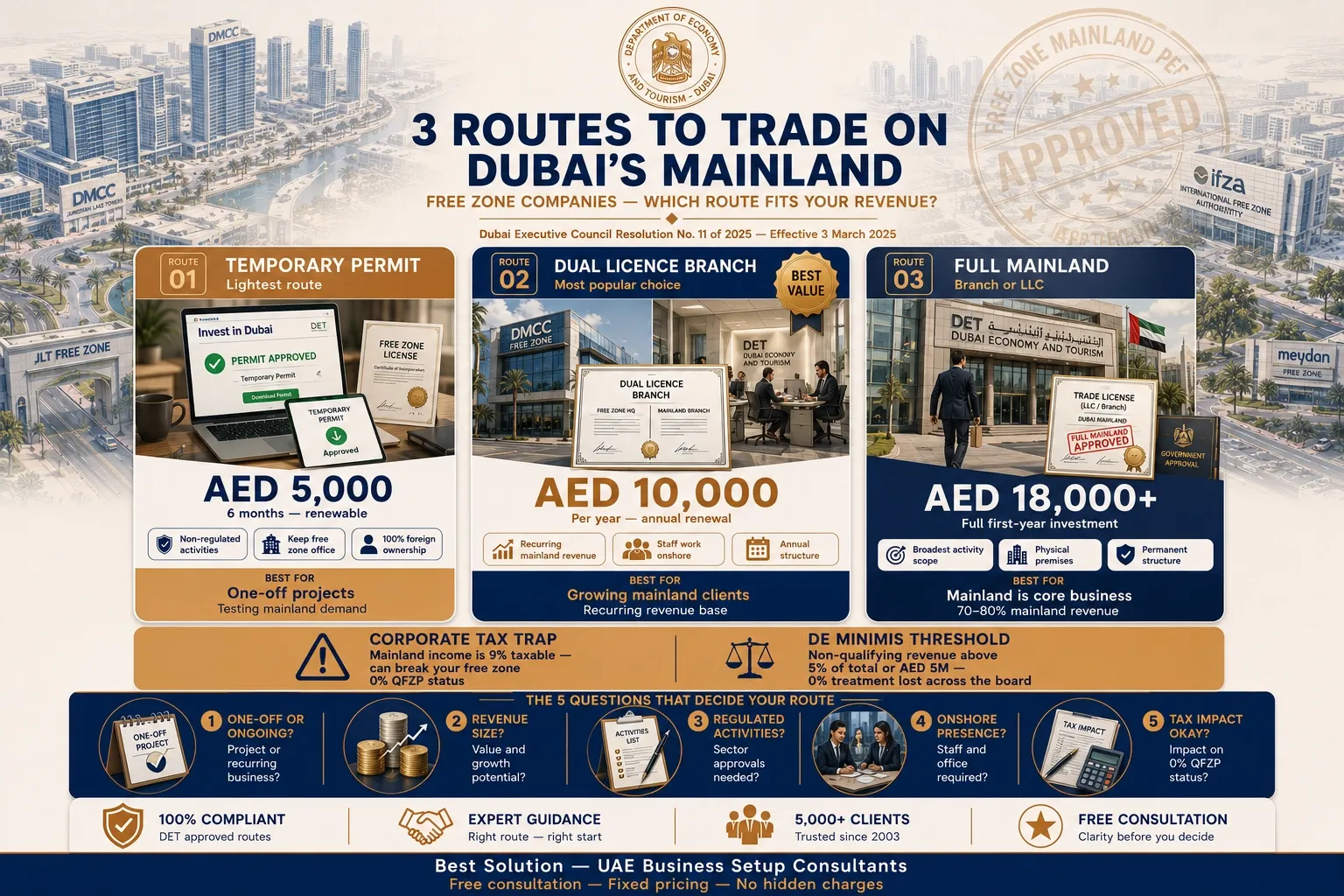
When a free zone company lands its first big mainland client, five questions usually settle the route within minutes:
Is this a one-off contract or recurring revenue?
- What share of annual revenue could mainland clients represent?
- Will staff work physically on the mainland?
- Are more mainland clients likely to follow? One often becomes several.
- Does maintaining QFZP status matter to you?
| Your Situation | Route That Usually Fits |
|---|---|
| One-off project or occasional mainland revenue | Temporary permit (6 months, AED 5,000) |
| Growing, recurring mainland client base | Dual licence branch (1 year, AED 10,000) |
| Mainland is the majority of revenue | Full mainland branch or LLC |
As one of our consultants puts it: the answer becomes obvious once you stop discussing licences and start discussing revenue. Companies sometimes cling to their original free zone structure after the commercial reality has changed. If 70 to 80 percent of revenue now comes from mainland clients, the honest advice is to stop forcing a free zone structure to do a mainland company's job.
Missed the regularisation deadline? What to do now
Companies already conducting mainland business were given one year from the resolution's effective date (3 March 2025) to regularise their position, with one possible extension. That window has now closed for most. The worst response is the common one: nothing has happened yet, so it is probably fine.
In practice, UAE enforcement tends to surface at a touchpoint: a bank, the tax authority, a major corporate client, a government tender, a compliance review, or a licence renewal. What Best Solution is seeing now is rising scrutiny of commercial substance and operating legitimacy, rather than blanket enforcement. The pattern is clear: companies that fix the issue early spend far less than those who wait until a bank, regulator, or major client finds it first.
Already trading on the mainland without the right structure? The first step is a review of your activities, revenue sources, client locations, tax exposure, and licensing setup. Only then should you choose between a permit, a dual licence, or a full mainland licence. Waiting rarely improves the position.
Quick reference
Work out the right route before you apply
Best Solution has guided entrepreneurs through the UAE's regulatory changes since 2003, with more than 5,000 companies formed and 4,500+ corporate bank accounts opened from our base in Business Bay. We can model your revenue mix, check your QFZP exposure, and tell you honestly whether a permit, a dual licence, or a full mainland licence is the right call, before you spend on the wrong one. For a structure review, call +971 4 553 1546 or visit our Business Bay office.