If you have read anything about setting up a company in Dubai in the last few years, you have probably hit the same confusing wall. One article insists you need a UAE national to own 51% of your business. The next tells you that foreigners can own 100% of everything. Both cannot be right, and the gap between them is exactly where most entrepreneurs lose money, sign the wrong agreement, or pay for a sponsor they never needed.
Here is the short version, then the detail. In 2026, most mainland business activities in Dubai allow full foreign ownership, so a traditional local sponsor is no longer required for them. A local sponsor or local service agent is still needed for specific regulated activities and certain legacy structures. The real question is no longer whether you need a sponsor. It is whether your activity triggers a local participation or regulatory requirement at all.
This guide walks through what a local sponsor actually is, when you still need one in 2026, what each structure costs, how to vet a sponsor properly, and the single mistake that costs business owners the most. The figures and examples come from Best Solution, a Business Bay business setup consultancy that has formed more than 5,000 companies in the UAE since 2003.
Local sponsor in Dubai at a glance
| Question | Short answer |
|---|---|
| Do you need a local sponsor in 2026? | Usually not. Most mainland activities allow 100% foreign ownership; free zones never needed one. |
| When is one still required? | Strategic-impact sectors (banking, insurance, telecom, defence, Hajj/Umrah and a few others) and some legacy structures. |
| The three structures | Individual sponsor (holds shares), corporate nominee (UAE company holds shares), local service agent (no shares). |
| What it costs per year | Individual AED 5,000–25,000+; corporate nominee AED 10,000–30,000+; LSA AED 3,000–15,000. |
| The mistake that costs most | Not documenting the relationship properly — not the choice of sponsor itself. |
Do You Need a Local Sponsor in Dubai in 2026?
DIRECT ANSWER
In 2026, most standard mainland activities in Dubai do not require a local sponsor, because full foreign ownership now applies across more than 1,000 commercial and industrial activities. A local sponsor or local service agent is only required for specific strategic-impact sectors or certain legacy and regulated structures.
The UAE amended its Commercial Companies Law, and full foreign ownership is now permitted across more than 1,000 commercial and industrial activities. IT, e-commerce, marketing, consultancy, design, software, and most professional and trading activities can be 100% foreign owned with no local shareholder. Free zone companies have never required a local sponsor.
Where a local sponsor or local service agent is still genuinely required is a defined list of activities the UAE classifies as having strategic impact. These include banking and finance companies, exchange houses, insurance, telecommunications, defence and military activities, Hajj and Umrah services, certain fisheries activities, and Quran memorisation centres.
The authoritative reference for which activities remain restricted is the UAE Government’s full foreign ownership guidance and the official foreign ownership restrictions list published by Invest in Dubai.
There is a more useful distinction underneath all of this. It is the one Best Solution puts to clients first. Many activities technically allow 100% foreign ownership but still require sector-regulator approval before they can operate. Healthcare and medical clinics, educational institutions, some engineering activities, security services, financial services, and telecom-related activities often fall here. They do not need a 51% Emirati shareholder. They do need professional qualifications, local representation, or sector-specific compliance sign-off. So the sharper question for 2026 is not “do I need a local sponsor.” It is “does my activity require regulatory participation, approvals, or oversight beyond standard company formation.” That is where most modern setup challenges actually arise.
What Is a Local Sponsor in Dubai?
A local sponsor in Dubai is a UAE national, or a company wholly owned by UAE nationals, who holds a stake or a formal role in a foreign-owned mainland company so it can be licensed. Under the older system, the sponsor held 51% of the shares on paper while the foreign owner ran the business. Today that role survives only in narrower circumstances.
The word sponsor gets used loosely, and that vagueness is where confusion starts. There are three distinct arrangements, and they are not interchangeable. An individual local sponsor is an Emirati who holds shares in a commercial LLC. A corporate nominee sponsor is a UAE-owned company that holds that stake instead of a person. It tends to give cleaner governance and continuity. A local service agent, or LSA, holds no shares at all. An LSA is appointed for certain professional licenses purely to handle government liaison. It is paid a fixed annual fee with no claim on profits or control. Mixing these three up is the most common reason an entrepreneur ends up in the wrong structure.
Local Sponsor vs Local Service Agent vs Corporate Nominee
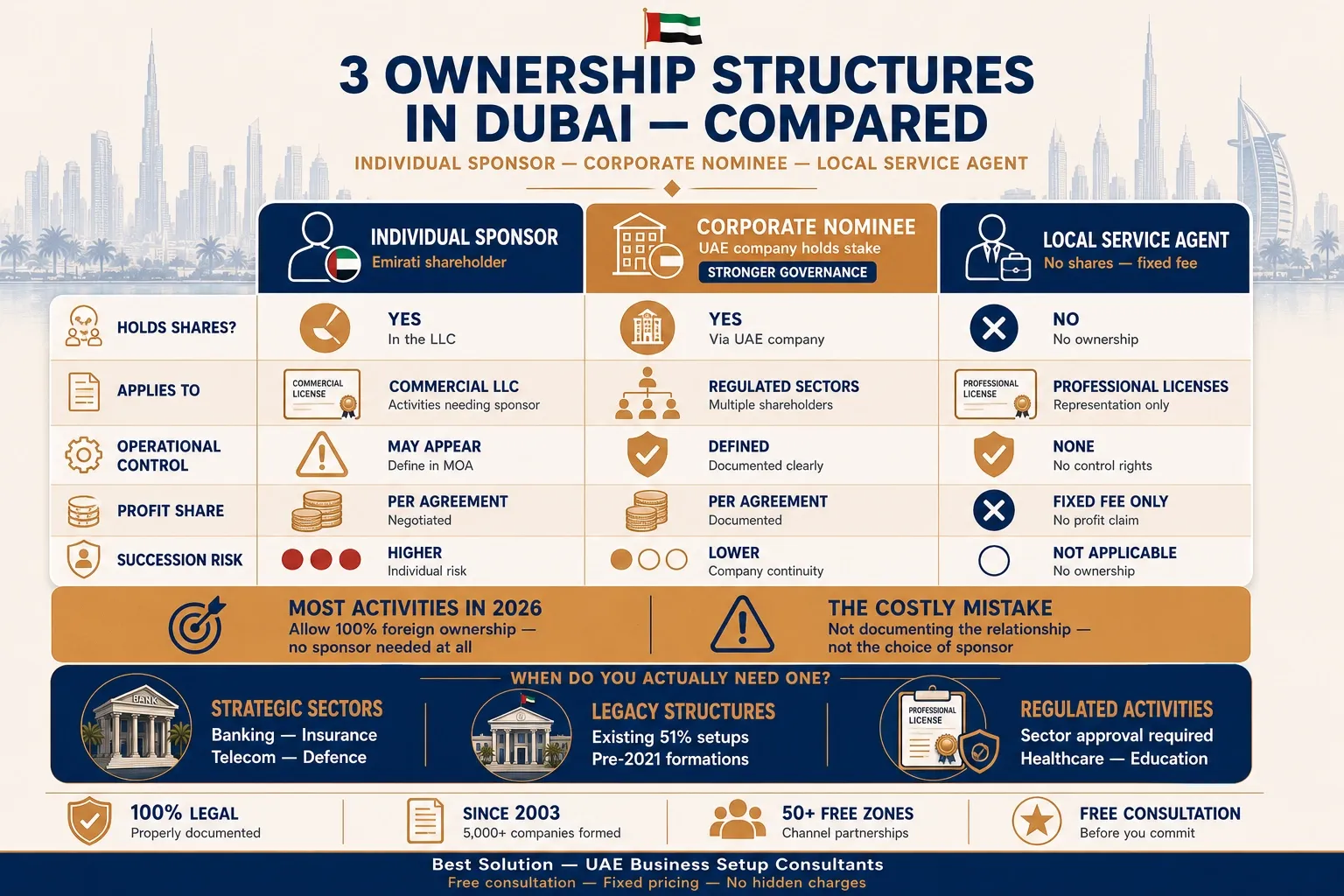
Because these three structures are confused so often, here is how they differ in practice.
| Feature | Individual Sponsor | Corporate Nominee | Local Service Agent |
|---|---|---|---|
| Holds shares? | Yes (in the LLC) | Yes (via UAE company) | No |
| Applies to | Commercial LLC activities still needing a sponsor | Same, where governance/continuity matters | Professional licenses |
| Operational control | May appear in structure | Defined, documented | None |
| Profit share | Per agreement | Per agreement | Fixed annual fee only |
| Succession risk | Higher (individual) | Lower (company continuity) | Not applicable |
An individual local sponsor may hold an ownership share and appear in the company structure. They apply to commercial LLC activities that still require a sponsor, and may share profit depending on the agreement. A corporate nominee sponsor holds the same required share, but through a UAE-owned company. That gives stronger governance, clearer documentation, and far less succession risk than an individual. A local service agent holds no ownership and has no operational control. They apply to professional licenses and are paid a fixed annual fee. If your activity allows full foreign ownership, you may need none of them.
How Much Does a Local Sponsor in Dubai Cost?
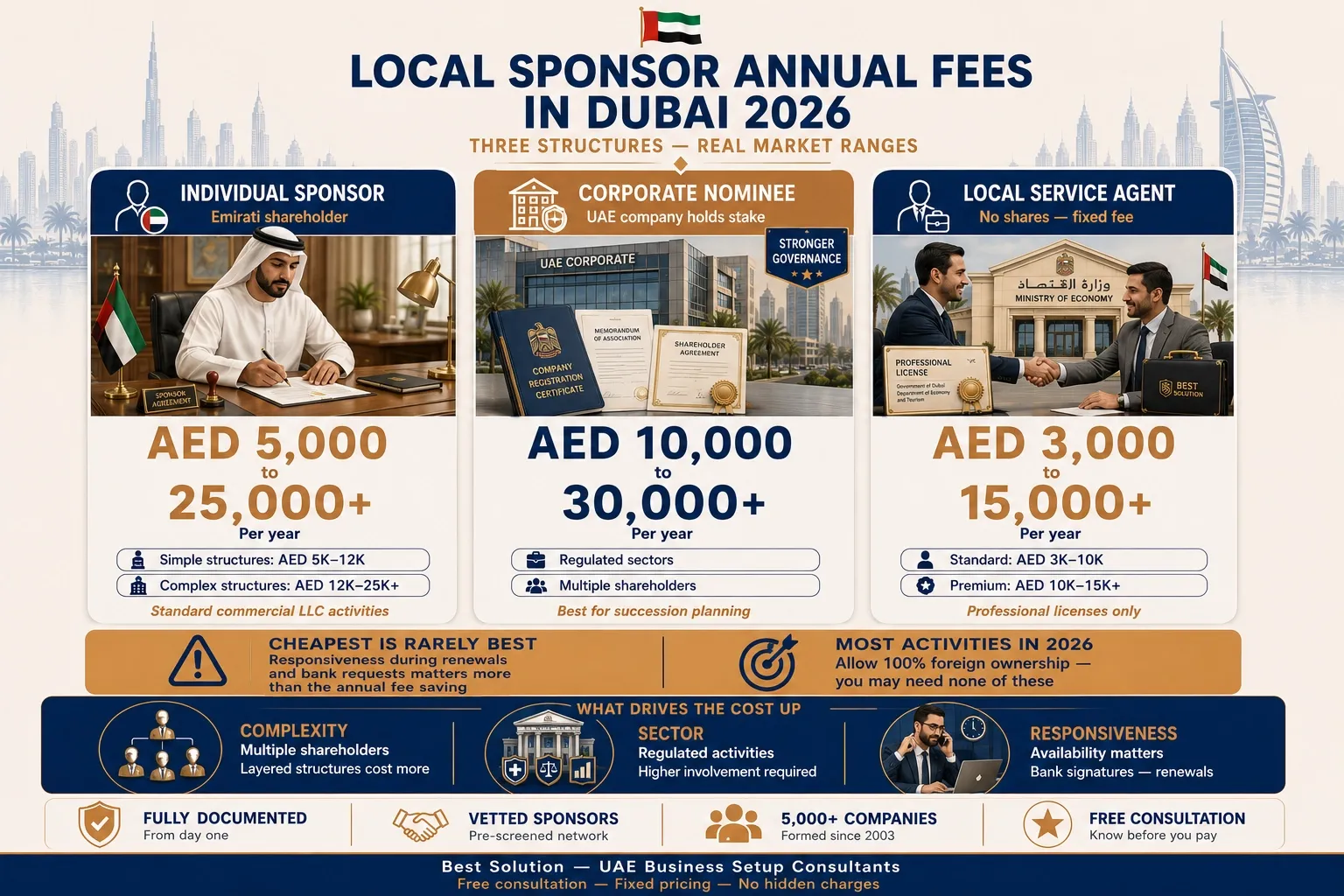
Online quotes of AED 5,000 to AED 25,000 a year for a local sponsor are broadly accurate, but the real number depends on your activity, the complexity of the structure, and how much involvement is required. The ranges below reflect what Best Solution sees in practice in 2026.
| Structure | Typical Annual Fee | Best Suited To |
|---|---|---|
| Individual Emirati sponsor | AED 5,000–12,000 (simple); 12,000–25,000+ (complex) | Standard commercial/professional LLC activities that still require a sponsor |
| Corporate nominee sponsor | AED 10,000–30,000+ | Regulated sectors, multiple shareholders, succession-sensitive setups |
| Local service agent (LSA) | AED 3,000–10,000 (premium 10,000–15,000+) | Professional licenses needing representation, not ownership |
WHAT INVESTORS OVERLOOK
The cheapest sponsor is rarely the best one. Responsiveness during license renewals, bank requests, MOA amendments, and government procedures is worth far more than the few thousand dirhams a year you might save on the fee. A sponsor who is unreachable when your bank asks for a signature can cost you weeks.
How to Find and Vet a Local Sponsor in Dubai
If your activity does require a sponsor or agent, vetting matters more than price. Work through these checks before you commit:
- Confirm UAE residency. A non-resident sponsor means travelling for every signature and government formality.
- Check background and standing. A sponsor from a well-regarded family carries genuine goodwill in the local market.
- Get fee and scope in writing. No ambiguity about what is and is not included.
- Review the sponsorship deed. Have it checked by a professional before you sign.
- Take licensed advice. Use a consultant who has handled the structure before, not a personal introduction alone.
Whatever you do, document the relationship fully before the company is formed. This is the part that separates clean setups from expensive ones.
Not sure whether your activity needs a sponsor, a nominee, an LSA, or none at all
A short consultation with Best Solution maps your activity to the right structure before you spend a dirham
The Costliest Mistake in Sponsor Arrangements
Here is the part most guides skip. The costliest mistakes in sponsor and partner arrangements are almost never legal errors on paper. They are governance and relationship failures: no clear shareholder agreement, undefined decision-making authority, profit-sharing that was discussed but never documented, no succession plan, and choosing a sponsor on price alone.
A real example from Best Solution’s casework shows how this plays out. A foreign investor entered a mainland trading business with a local individual introduced through a personal connection. The company formed without a problem. But future expansion rights, branch ownership, and banking authority were never properly documented. As the business grew, disagreements surfaced over management authority and expansion plans. Resolving it required MOA amendments, a restructuring of the shareholder arrangement, banking updates, and revised corporate documentation. The direct government costs were manageable. The real loss was several months of operational momentum while the business untangled something that a proper agreement on day one would have prevented.
The lesson is blunt: choosing the right sponsor matters less than documenting the relationship properly from the start.
Partner, Nominee, LSA, or Free Zone: How to Decide
The decision should never begin with “do I need a sponsor.” It should begin with “how will the business actually operate.” That reframing usually answers the structure question on its own. It is the same logic behind the free zone versus mainland decision.
- Genuine equity partner — when the local partner contributes real value: capital, clients, government contracts, market access, industry expertise, or strategic relationships. If they add nothing beyond a signature, equity is the wrong call.
- Corporate nominee sponsor — when local participation is genuinely required and you want stronger governance, especially with multiple shareholders or where succession risk matters.
- Local service agent — where the rules require representation but not ownership, the typical professional-license case.
- Free zone — when most revenue comes from international clients, the business runs digitally, local operations are limited, or direct UAE market access is not the main objective.
THE 80% RULE
Best Solution applies one decision rule across the whole setup question, including ownership structure: where will roughly 80% of your first-year revenue come from? If it is the UAE market, a mainland structure usually fits. If it is international or online, a free zone usually wins. That single answer tends to set ownership structure, jurisdiction, banking profile, and long-term strategy together, rather than treating the sponsor decision in isolation.
Why Entrepreneurs Set Up With Best Solution
Best Solution has formed more than 5,000 companies and opened over 4,500 corporate bank accounts in the UAE since 2003. The firm works from Business Bay with more than 50 free zone channel partnerships across DMCC, IFZA, Meydan, SHAMS, DIFC, Dubai South, RAKEZ, and JAFZA. Since the foreign ownership reforms, the share of new businesses needing a traditional 51% sponsor structure has dropped substantially. Most foreign investors setting up standard mainland businesses now achieve full ownership without one. Where a sponsor, nominee, or local service agent is genuinely required, Best Solution arranges it with the documentation in place from day one. The firm was named RAKEZ Best Business Partner in 2021, 2022, and 2025.