You are partway through setting up a UAE company, and a bank, free zone, or checklist has just asked for your Certificate of Incorporation. This guide tells you exactly what the document is, who issues it, what it contains, what it costs in 2026, and the one thing it does not do: permit you to trade. We form companies for a living (5,000+ since 2003), so we will also show you what banks actually check when they see your COI, because that is where most setups stall. International founders typically compare a free zone company setup with a mainland licence before filing.
| Question | Short answer |
|---|---|
| What it proves | Your company legally exists as a registered entity in the UAE |
| Who issues it | Department of Economy and Tourism (mainland), the free zone authority, or an offshore registrar |
| Separate fee? | No. It is included in your company formation package |
| Validity | Permanent. It does not expire; only your trade license renews annually |
| What it is not | A permit to operate. You need a trade license for that |
What Is a Certificate of Incorporation in the UAE?
A Certificate of Incorporation (COI) is the legal document confirming that your company has been registered and recognised as a legal entity under UAE law. It is issued once, at the moment of company formation, by the Department of Economy and Tourism for mainland companies or by the relevant free zone authority for free zone companies. If you choose a limited company, forming an LLC sets the ownership and management terms recorded on the COI.
Think of it as your company's birth certificate. It records the company name, registration number, and date of incorporation, and it establishes the business as a separate legal entity, distinct from its shareholders. That separation is what protects your personal assets if the company runs into debt or litigation.
The certificate matters because almost everything downstream depends on it. You need it to open a corporate bank account, sponsor visas, bid for government tenders, sign office leases, and complete corporate tax registration with the Federal Tax Authority. Each of these processes asks for it as proof of legal existence. Once the entity exists, corporate tax registration with the Federal Tax Authority follows.
Who Issues the Certificate of Incorporation?
The issuing authority depends on the jurisdiction you registered in. There are three routes:
Mainland. The Department of Economy and Tourism (DET) in each emirate issues the certificate. In Dubai this body was formerly the Department of Economic Development (DED), and you will still see both names used. Mainland registration follows the framework set by the Ministry of Economy and Tourism and Federal Decree-Law No. 32 of 2021 on Commercial Companies. Incorporation begins with trade name registration, reserved before the certificate is issued.
Free zone. Each free zone authority issues its own certificate: DMCC, IFZA, Meydan Free Zone, SHAMS, JAFZA, Dubai South, RAKEZ, and around 40 others. Formats differ slightly between zones, which is normal and does not affect validity.
Offshore. Registrars such as RAK ICC and JAFZA Offshore issue COIs for offshore entities, usually through a registered agent.
A note on a claim you may read elsewhere: free zone COIs are not exclusively available through channel partners. Many free zones accept direct applications. Others route most registrations through approved channel partners and authorised consultants. Complex structures (multiple shareholders, corporate shareholders, regulated activities) are consistently easier through that route. Best Solution holds channel partnerships with 50+ free zones, which is what allows direct liaison with the authority when an application gets stuck.
What Information Does the COI Contain?
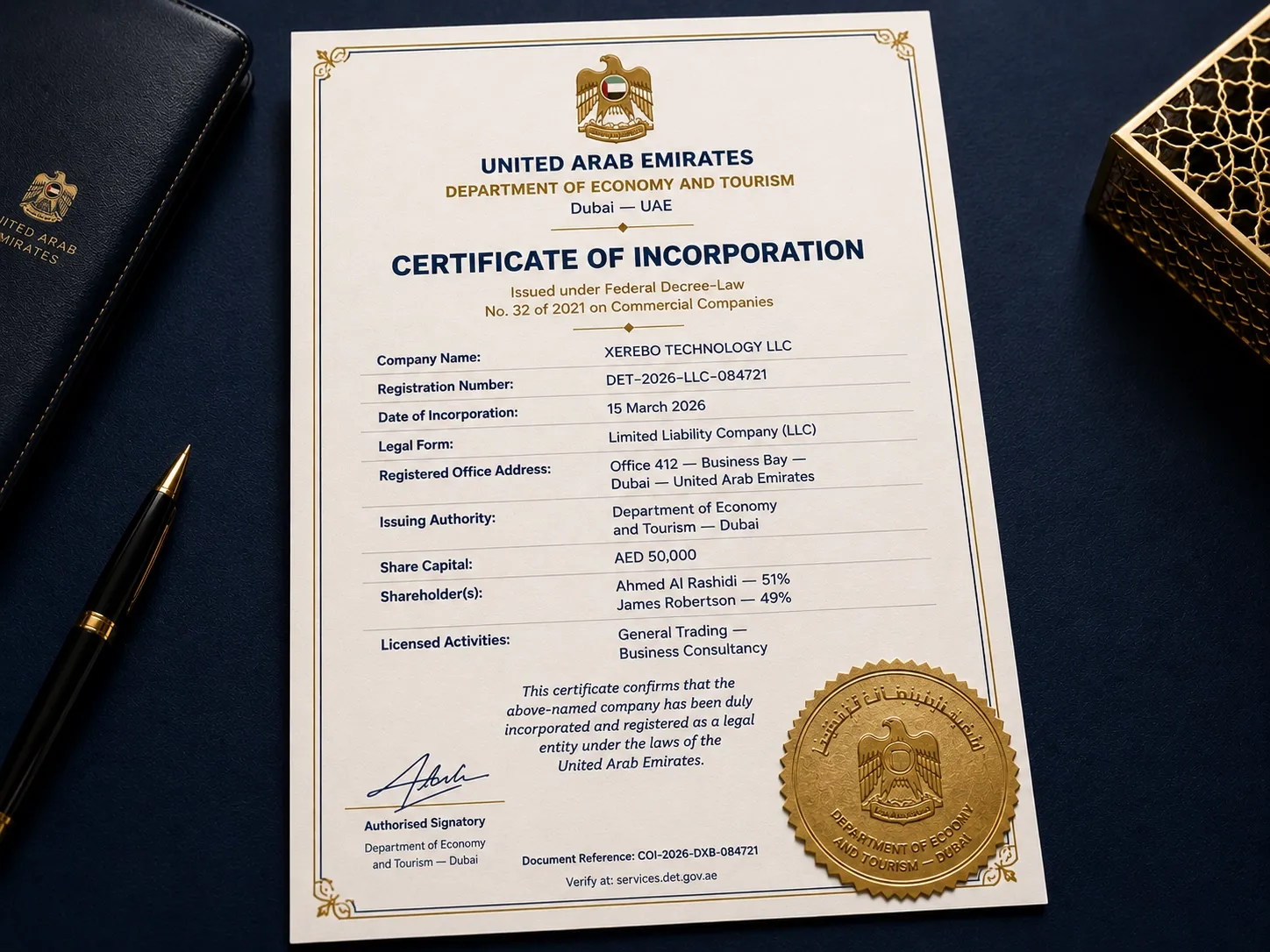
Layouts vary by authority, but a UAE Certificate of Incorporation typically records:
- Full legal name of the company, as approved at trade name reservation
- Company registration number, the unique identifier used in all official records
- Date of incorporation
- Legal form: LLC, Free Zone Establishment (FZE), Free Zone Company (FZCO), branch of a foreign company, or sole establishment (sole proprietorship)
- Registered office address in the UAE
- Issuing jurisdiction and authority
- Share capital, where applicable
- Names of shareholders or directors (sometimes in the accompanying Memorandum of Association instead)
- Stamp and signature of the issuing authority
Check every field the day you receive it. A spelling difference between your COI and your Memorandum of Association (MOA) is exactly the kind of inconsistency that triggers questions later, usually from a bank.
Why Banks Care More About Consistency Than the Certificate Itself
Here is what surprises most founders: in 4,500+ corporate bank accounts we have helped open, the Certificate of Incorporation alone has almost never caused a rejection. Banks treat it as one input in a wider consistency review. That review is driven by UAE Anti-Money Laundering (AML) and Counter-Terrorism Financing (CTF) rules, which set stricter documentation standards than most other countries. Banks run AML compliance checks on the company and its owners during onboarding.
What compliance teams actually check during KYC (Know Your Customer) review:
- Legal existence. The company exists and the registration number matches authority records.
- Shareholder structure. Ultimate beneficial owners (UBOs) align with the corporate documents, and ownership percentages are consistent everywhere they appear.
- Activity alignment. The COI, trade license, MOA, and business plan must all describe the same business. Banks lean most heavily on the MOA, because it names who manages the account and who holds signing authority.
- Jurisdiction fit. The claimed activity, expected transaction volume, and geographic exposure have to make sense together.
One recurring rejection pattern from our files: a client incorporated a consultancy, then presented the bank a business plan describing commodity trading and international import-export payments. The license said one thing, the MOA another, the plan a third. The application sat in enhanced due diligence until the documents were corrected. The COI was never the problem. The story was.
The practical lesson: the fastest approvals happen when the COI, trade license, MOA, business plan, website, and expected transaction profile all tell the same story. If you are at this stage, our guide to opening a business bank account in Dubai covers the full file banks expect. Budgets vary by structure, so review the full cost of starting a business in Dubai first.

Your COI Is Step One. Let's Make Sure the Rest Lines Up
Most founders receive their Certificate of Incorporation and assume they're done. We'll make sure your COI, trade license, MOA, and banking file all tell the same story — from day one
How to Get a Certificate of Incorporation in UAE: Step by Step
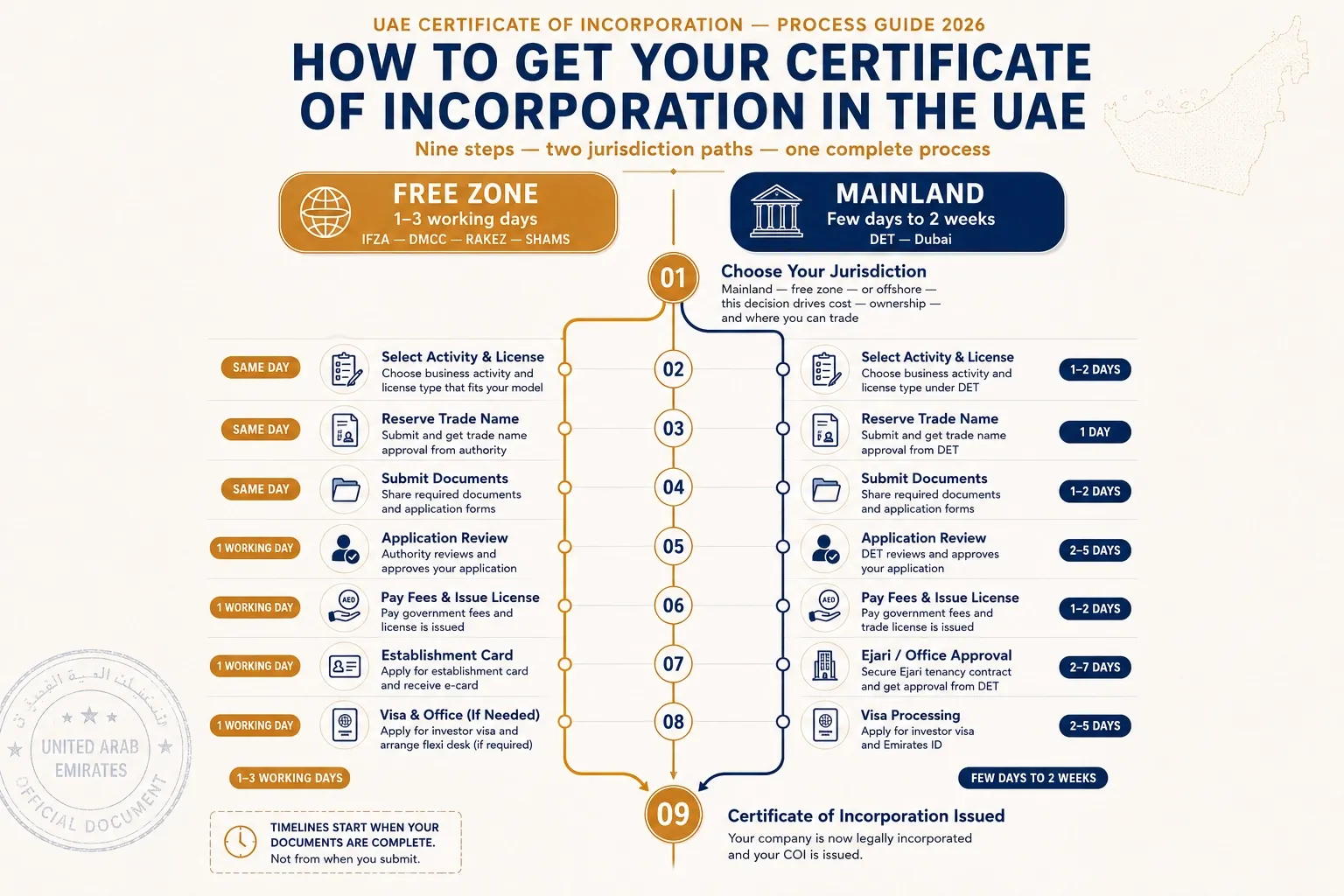
Dubai alone issued nearly 19,000 new business licences in the first quarter of 2025, roughly 59% of the UAE total, according to Department of Economy and Tourism figures. Company incorporation in Dubai, and across the UAE, follows the same sequence. The Certificate of Incorporation is issued at the end of it:
- Choose your jurisdiction. Mainland, free zone, or offshore. This decision drives cost, ownership structure, and where you can trade. Our free zone vs mainland comparison walks through the decision; the short version of our framework is to ask where roughly 80% of your year-one revenue will come from. Inside the UAE points to mainland; outside points to free zone.
- Select your business activity. Every authority licenses from an approved activity list, and the wrong classification causes delays and bank friction later. Choosing your business activity is worth getting right the first time.
- Reserve a trade name that complies with UAE naming rules, with the DET or the free zone authority.
- Apply for initial approval, confirming the authority has no objection to the proposed company, shareholders, and activity.
- Prepare and notarise legal documents, principally the MOA and, where required, Articles of Association (AOA).
- Secure premises. A tenancy contract registered through Ejari for mainland, or a lease or flexi-desk package inside a free zone.
- Obtain any external approvals required for regulated activities (health, education, financial services and similar).
- Pay fees and submit the final application with all approved documents.
- Receive your Certificate of Incorporation, typically issued together with your trade license.
How long does it take?
For standard structures with complete, compliant documents: one to three working days in most free zones, and a few days to two weeks for mainland, depending on external approvals. At the fast end, Ajman's NuVentures free zone has issued COIs in as little as three hours. IFZA, Meydan, and SHAMS are also consistently quick. Zones with deeper compliance checks, such as DMCC, take longer by design.
The honest caveat: every fast timeline you see quoted, including ours, starts from the moment your documents are complete and compliant. A Chinese trading client came to us after three weeks stuck at another consultancy. They had picked a free zone that did not match his activity and never verified his shareholder documents. We ran a compliance review, corrected the activity classification, and resubmitted. His Certificate of Incorporation was issued within 48 hours. The 48 hours was real. But the bottleneck all along was document preparation, not authority processing.
What Documents Are Required?
Requirements vary by legal structure. The core sets:
- Completed application form
- MOA and AOA
- Passport copies of all shareholders and the appointed manager
- No Objection Certificate (NOC) from the current sponsor, where a shareholder holds a UAE residence visa
- Proof of registered address (Ejari or lease)
- Completed application form
- Passport copies of shareholders and manager
- Business plan (required by most zones, and read more carefully than founders expect)
- Trade name reservation confirmation
- Lease or flexi-desk agreement within the zone
- Share capital deposit, where the zone sets a minimum
- Parent company's own Certificate of Incorporation, attested
- Board resolution authorising the branch
- Power of attorney for the local manager
- Parent company MOA and AOA
- Manager's passport and visa copies
How Much Does a Certificate of Incorporation Cost in UAE?
There is no separate fee for the certificate itself. It is included in the company formation package, so the real question is what formation costs. Current market ranges, as of mid-2026:
| Setup | Realistic range | Notes |
|---|---|---|
| Entry free zone package (license + COI + registration) | AED 6,500–9,500 | Market spread runs AED 4,888–12,520 depending on zone |
| Free zone with one visa, first year | AED 13,000–22,000 | Varies with zone, activity, shareholder count, visa type, and whether you are inside or outside the UAE |
| Mainland company, first year | AED 18,000–35,000+ | Driven by activity, external approvals, office requirement, and immigration setup |
| COI amendment | AED 1,000–2,500 | Name change, shareholder or director updates, activity adjustment |
| Complex restructuring | AED 3,000–5,000+ | Authority fees plus legal drafting and approvals |
Entry packages typically exclude visa costs, medical tests, Emirates ID, and the establishment card, which is where "the authority quoted me less than the consultant" usually comes from. The authority's number is real. It just is not the whole number. After the COI, the establishment card opens the company’s immigration file.
These figures are market ranges, not quotes. Costs vary by authority and change without notice; confirm current fees with the issuing authority or your consultant before budgeting. This is general information, not legal or financial advice.
How Long Is the Certificate of Incorporation Valid?
The Certificate of Incorporation is permanently valid. It does not expire and does not renew. What renews annually is your trade license. That distinction trips up founders every year, because letting the license lapse puts the company out of compliance even though the COI remains untouched.
You will need a fresh or amended COI only when core company details change: legal name, ownership, legal structure, or registered activity. In most free zones a straightforward amendment completes within 3 to 7 business days; mainland amendments can take longer when external approvals are involved. Each of these ties back to your legal form, so it helps to understand the types of business structures in the UAE up front.
If you need a copy, mainland companies can download license and registration documents through the DET eServices portal with a UAE Pass login. Free zone companies request copies from their zone's portal or through their consultant, and offshore companies go through their registered agent.
Certificate of Incorporation vs Trade License: What Is the Difference?
The two documents answer different questions. The COI answers "does this company legally exist?" The trade license answers "what is this company allowed to do?"
| Feature | Certificate of Incorporation | Trade License |
|---|---|---|
| Purpose | Proof of legal formation and existence | Permission to conduct specific activities |
| Issued | Once, at incorporation | Annually renewable |
| Contains | Name, registration number, date, legal form | Licensed activities, license number, validity dates |
| Needed for | Bank account, contracts, legal identity | Actually operating and invoicing |
You need both. A French SaaS founder came to us through a BNI referral after a previous consultancy formed his company and stopped there. He had no banking guidance, a thin business plan, and a compliance file no bank would pass. His company existed on paper and could do nothing. We rebuilt the compliance file, aligned the declared activity across his documents, and coordinated the bank referral. The account was approved within the bank's normal compliance timeframe. He was invoicing UAE and international clients within weeks.
This is the most common COI misconception we see: founders receive the certificate and assume they can start operating. The COI confirms incorporation. It does not mean visas are processed, banking is approved, regulated activities are authorised, or tax registrations are complete. For what the license side involves, see the types of trade license in Dubai.
You can verify any UAE business registration through the official UAE government licence inquiry service.
COI Attestation for International Use
A section most guides skip entirely: what happens when your UAE COI needs to work outside the UAE, or a foreign company's COI needs to work inside it.
Foreign banks, tax authorities, and tender bodies generally will not accept an unattested certificate. Attestation runs the document through a sequence of certifications, ending with the UAE Ministry of Foreign Affairs (MOFA) stamp, and for outbound use, embassy or consular legalisation for the destination country. Typical triggers:
- A foreign parent company registering a UAE branch (the parent's COI must be attested)
- UAE companies opening overseas bank accounts or subsidiaries
- Cross-border contracts and overseas government tenders
- Foreign tax authority filings
Most entrepreneurs discover the requirement only after a foreign institution rejects their document. If international use is anywhere in your plan, build attestation in from the start; our UAE attestation service handles the full chain, including government-certified copies.
Your COI Is Step One, Not the Finish Line
The Certificate of Incorporation in UAE gives your company legal existence: a name, a number, and standing to open accounts, sign contracts, and sponsor visas. What it does not give you is an operating business. That takes a trade license, a bank account that passes compliance, and documents that tell one consistent story. From here, our full guide on how to start a business in Dubai walks through every remaining step.
Best Solution has been doing exactly this work from Business Bay since 2014, with 5,000+ companies formed and channel partnerships across 50+ free zones, recognised as RAKEZ Best Business Partner in 2021, 2022, and 2025. Packages start from AED 6,500, priced fixed .