The expensive part of company formation in Dubai is almost never the setup. It is the restructuring after a setup that was wrong from the start.
That one idea should reframe how you approach this decision. Most founders compare licence prices, pick the cheapest package they find online, and treat formation as paperwork. Then, six to twelve months later, a bank declines the account, an activity turns out to be missing from the licence, or a free zone company cannot legally service a mainland client. At that point the company is being rebuilt, not adjusted, and the bill runs well past what the original setup cost.
This guide is built from what a Dubai business setup consultancy actually watches go wrong. Best Solution has handled company formations across mainland, free zone and offshore jurisdictions, and the same errors repeat with remarkable consistency. Below are 21 of them, grouped by where they happen in the process. Each one explains the risk in plain terms and how to avoid it. The goal is simple: help you set up once, correctly.
Key Takeaways: Company Formation in Dubai
| Key Point | Summary |
| Biggest mistake | Choosing a setup on headline price instead of how the business will actually operate. |
| Mainland vs free zone | Neither is “better”. The right choice depends on who your customers are and where you operate. |
| Real cost | The licence fee is one line item. Budget for visas, Emirates ID, medicals, office and banking on top. |
| Tax | UAE corporate tax is 9% on taxable income above AED 375,000; VAT registration is mandatory above AED 375,000 turnover. |
| Most overlooked step | The corporate bank account. Your jurisdiction and activity choice decide whether a bank will onboard you. |
What Is the Most Common Company Formation Mistake in Dubai?
The most common company formation mistake in Dubai is choosing a setup based on the lowest licence price rather than on how the business needs to operate. A cheap free zone package can block mainland clients, fail bank onboarding, or cap visa numbers. Correcting any of those later costs far more than setting up correctly the first time.
Strategic Setup Mistakes
The first five mistakes happen before a single document is filed. They are decisions about jurisdiction, structure and activity, and they are the ones that are most expensive to reverse.
1. Choosing Your Setup on Headline Price, Not Operational Reality
This is the mistake Best Solution sees most often, and it is the one generic guides never mention. Founders compare licence packages and pick the cheapest, without checking whether that structure supports how the business will run 6 to 12 months later.
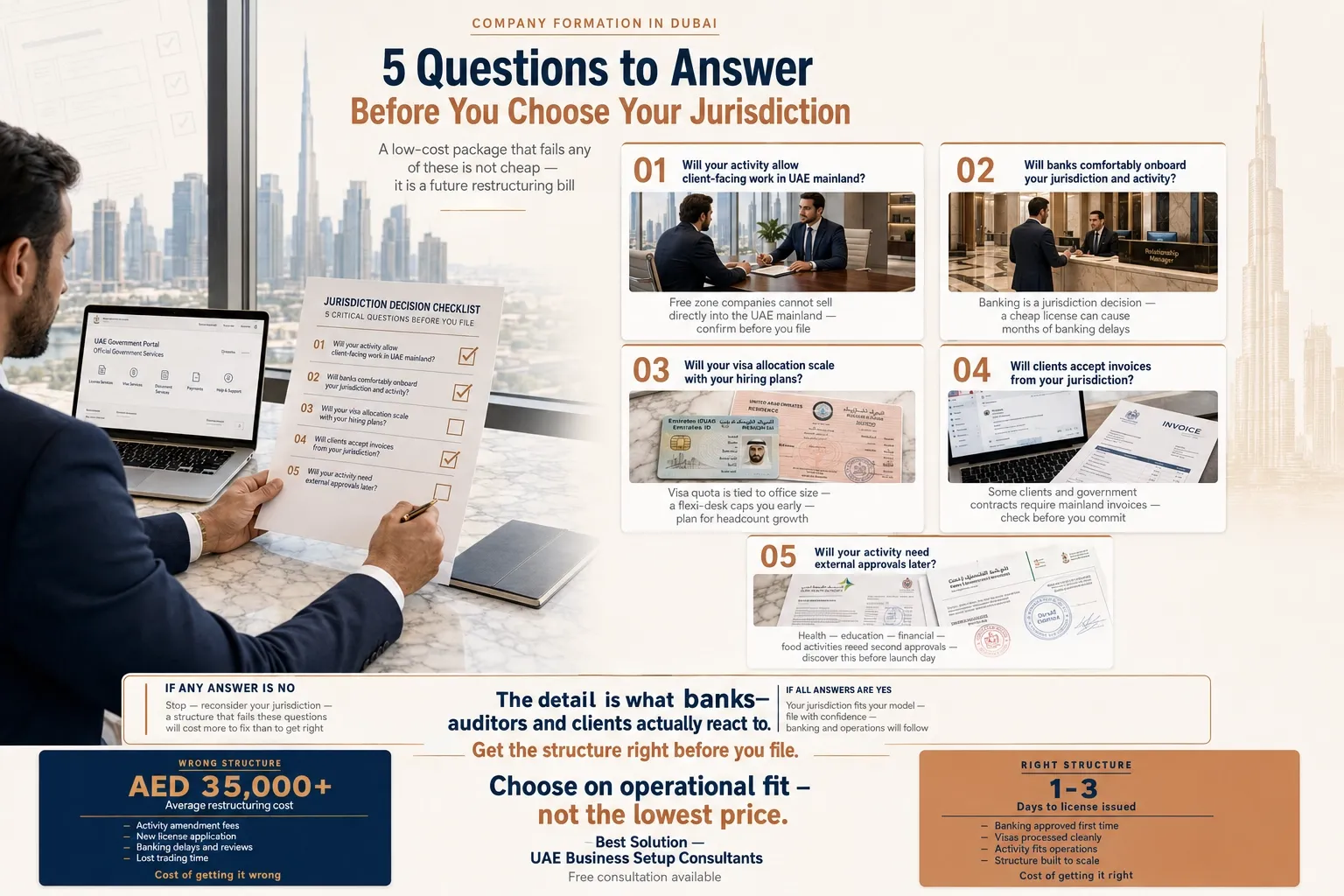
Before you commit, five questions decide whether a setup is actually viable: does the activity allow client-facing work in the UAE mainland; will banks comfortably onboard that jurisdiction and activity combination; will the visa allocation scale with your hiring plans; will the activity need external approvals later; and will your future clients accept invoices from that jurisdiction. A low-cost package that fails any of these is not cheap. It is a future restructuring bill. Compare the mainland licence services against a free zone option on operational fit, not price.
2. Treating “Mainland vs Free Zone” as the Whole Decision
“Mainland or free zone” is a useful starting question. It is not the whole decision. Two free zone companies with identical licences can have completely different outcomes depending on the zone, the exact activity wording, and how a bank reads that combination.
The real decision is operational: where your customers are, where you will physically work, how you will get paid, and how fast you expect to grow. Founders who reduce setup to a two-box choice tend to get the box right and the detail wrong. The detail is what banks, auditors and clients actually react to.
3. Picking a Free Zone for Its Popularity, Not Its Fit
There are dozens of free zones in the UAE, including DMCC, IFZA, Meydan Free Zone, RAKEZ, SHAMS, JAFZA and DIFC. No single free zone is “best” for everyone. Some suit international trading, some are built for cost efficiency, some work better for digital businesses, and some are viewed more favourably by banks for a given activity.
The common mistake is choosing a zone because it is visible on social media or running a promotion, then comparing only setup price and visa count. The questions that matter are different: how will banks view this structure, does the activity fit naturally inside that jurisdiction, is office scalability realistic, and how responsive is the authority during amendments and renewals. Choose the free zone company setup that matches the business model, not the lowest advertised package.
4. Choosing the Wrong Legal Structure
Sole establishment, civil company, limited liability company, branch, or a free zone FZE or FZCO: the structure you pick decides ownership, liability and how investors will view the company later. A solo consultant and a trading company with staff and suppliers should rarely use the same one. For most commercial and professional activities, foreign investors can now own 100% of a mainland company, a change introduced by the 2021 Commercial Companies Law reform (u.ae). A small set of strategic sectors still requires Emirati participation, so the structure should always be confirmed against the specific activity.
If you are weighing options, the sole proprietorship vs LLC comparison is a useful starting point before you file.
5. Registering a Business Activity That Does Not Match What You Sell
In the UAE, your business activity determines your licence type and the approvals you need. Register an activity that does not match what you actually sell, and you create real exposure: operating outside your licensed activity is treated much like operating without a licence, and it carries fines.
The fix is cheap and the failure is expensive. Map every activity the business will perform now and the closely related ones it is likely to perform within a year, and licence them together. Adding activities later means amendments, approvals and fees, and sometimes a banking review you did not want to trigger.
Mainland or Free Zone: How to Actually Decide
Most founders ask this question first, so it deserves a clear answer. The table below compares the three routes on the criteria that change real outcomes. Read it alongside one rule that catches people out constantly: a free zone company cannot sell directly into the mainland UAE market. It can trade inside its zone and internationally, but to reach mainland customers it must appoint a mainland distributor or open a mainland branch.
Comparison: Mainland vs Free Zone vs Offshore Company Formation in Dubai
| Criterion | Mainland | Free Zone | Offshore |
|---|---|---|---|
| Foreign ownership | 100% for most activities | 100% | 100% |
| Where you can trade | Anywhere in the UAE and abroad | Within the zone and abroad; mainland UAE only via a distributor or branch | Outside the UAE only; no UAE trading |
| Office requirement | Physical office or approved space usually required | Flexi-desk or office within the zone | No UAE office |
| Residence visas | Linked to office space; generally scalable | Capped by package and office size | No UAE residence visas |
| Corporate tax | 9% on taxable income above AED 375,000 | 0% on qualifying income for a QFZP, otherwise 9% | Depends on activity and substance |
| Best suited to | UAE customers, retail, government and corporate contracts | International or B2B service businesses, e-commerce | Holding companies, international structuring |
Indicative comparison only. Confirm current rules with DET, the relevant free zone authority, or a licensed advisor.
Cost and Budget Mistakes
The next four mistakes are about money, and specifically about the gap between the price a founder budgets for and the price the business actually pays in year one.
6. Believing the Licence Fee Is the Total Cost
A “AED 15,000 free zone package” is an advertised licence fee. It is not the cost of having an operating company. Once you add office space, visa processing, Emirates ID, medical tests and document attestation, that headline figure commonly lands somewhere closer to AED 35,000 to AED 45,000 before the business has earned a dirham.
Budget for the all-in first-year total, not the advertised line The real cost of starting a business in Dubai breaks this down further, and the table later in this article itemises the components.
7. Forgetting Visas, Emirates ID, Medicals and the Establishment Card
Company formation and immigration are two connected processes, and founders routinely budget for the first and forget the second. To put yourself and any staff on residence visas, the company needs an establishment card with the immigration authorities, and each visa runs through a medical fitness test, an Emirates ID application and biometrics.
Every visa is a recurring cost, not a one-off. If you plan to sponsor family members, add their applications too. A setup that looks affordable for one visa can look very different at five.
8. Treating the Corporate Bank Account as a Formality
Opening a corporate bank account in Dubai is the step founders underestimate most. Banks do not simply accept a trade licence. They assess the business model, the jurisdiction, the activity, the shareholders, the customer countries and the source of funds, and they decline applications that do not add up.
This is why jurisdiction and activity choice are, in practice, banking decisions. A structure that looked cheap can quietly become the reason an account takes months or stalls. Prepare a clear business plan, know your customer profile, and treat the business bank account in Dubai as a core part of the setup, not an afterthought.
9. Setting Up With No Contingency for Amendments and Renewals
Plans change. An activity gets added, a shareholder joins, an office is upgraded, the licence comes up for renewal. Each of these has a fee, and a budget built only around day-one costs has no room for any of them.
Build a contingency into the first-year plan. A sensible buffer on top of your projected setup and operating costs absorbs fee changes, regulatory updates and the amendments almost every growing company needs in its first year.

Still Weighing Your Options? Get the Structure Right Before You File.
Most restructuring bills start with a setup decision made on price. Before you commit to a jurisdiction, activity, or free zone, talk to a specialist who works backward from your business model, not the cheapest package. Best Solution gives you a clear, fixed-price answer with no hidden charges.
How Much Does Company Formation in Dubai Actually Cost?
There is no single price. A lean, single-visa free zone setup with no physical office can sit at the lower end, while a multi-visa mainland company with office space and regulated activities runs much higher. The honest answer is a range, and the figure that matters is the all-in first-year total, not the licence fee.
Indicative First-Year Cost Components: Company Formation in Dubai (AED)
| Criterion | Mainland | Free Zone | Offshore |
| Foreign ownership | 100% for most activities | 100% | 100% |
| Where you can trade | Anywhere in the UAE and abroad | Within the zone and abroad; mainland UAE only via a distributor or branch | Outside the UAE only; no UAE trading |
| Office requirement | Physical office or approved space usually required | Flexi-desk or office within the zone | No UAE office |
| Residence visas | Linked to office space; generally scalable | Capped by package and office size | No UAE residence visas |
| Corporate tax | 9% on taxable income above AED 375,000 | 0% on qualifying income for a QFZP, otherwise 9% | Depends on activity and substance |
| Best suited to | UAE customers, retail, government and corporate contracts | International or B2B service businesses, e-commerce | Holding companies, international structuring |
Indicative ranges only, for planning. Actual fees depend on the authority, activity, office choice and year. Confirm current figures with DET, the relevant free zone, or a licensed advisor before budgeting.

Licensing, Documentation and Structure Mistakes
Mistakes 10 to 14 happen in the paperwork. They rarely stop a licence from being issued. They tend to surface later, as delays, rejections or awkward questions from a bank.
10. Choosing a Trade Name That Triggers Extra Approvals
A trade name is a compliance asset, not just branding. Dubai’s Department of Economy and Tourism applies real rules: the name must reflect the licensed activity, must not use the names of religions, governments or external organisations, must show the legal form (for example, ending in “LLC”), and must carry an accurate Arabic translation. Restricted words trigger extra approvals or outright rejection (Dubai DET).
Some names also raise unnecessary questions during banking. Check the name for activity fit, restricted terms and Arabic translation before you print anything. A name that needs to change after launch costs momentum and credibility.
11. Rushing or Skipping the Memorandum of Association
The Memorandum of Association sets out shareholding, management authority and how profit is shared. Where there is more than one shareholder, it is the document that decides what happens when people disagree.
A vague or copy-paste MOA feels like a formality on day one. It becomes the center of the dispute on the day a partnership runs into trouble. Treat it as a genuine agreement between the founders, and have it reviewed before signing.
12. Underestimating Document Attestation and Translation
Foreign documents used in a UAE company setup often need attestation and certified legal translation, and that process takes time. Incomplete or incorrectly attested documents are one of the most common causes of registration delay.
There is also a detail founders miss: a shareholder’s nationality can change what documentation is required during banking and immigration. Confirm the full document list for your specific shareholders early, not on the day of submission.
13. Missing the External Approvals Your Activity Requires
Some activities need approval from a body beyond the licensing authority. Health, education, security, food, financial and several other regulated activities involve a second regulator, and that approval has its own timeline and conditions.
Founders who discover this after committing to a launch date lose weeks. Check whether your activity needs special approval before you build the plan around a go-live date, not after.
14. Picking the Wrong Office Solution for Your Activity
A flexi-desk is the cost-effective choice for many service businesses. But it does not suit every activity, and office size is often tied to how many residence visas a company can hold.
Choose the office solution against two things at once: what your activity legally requires, and how many visas you will need as you hire. A mainland company also needs a registered tenancy through Ejari. An office that fits today but caps your visas at the headcount you plan to reach is the wrong office.
Compliance and Tax Mistakes
Dubai is business-friendly, and it is also increasingly compliance-driven. Mistakes 15 to 18 are the obligations that founders treat as optional until an authority disagrees.
15. Ignoring UAE Corporate Tax Registration
UAE corporate tax applies at 0% on taxable income up to AED 375,000 and 9% above it, administered by the Federal Tax Authority. Registration is a legal obligation, and it applies even to businesses that expect to owe little or no tax, including many free zone companies.
Two points are widely misunderstood. A Qualifying Free Zone Person can access a 0% rate on qualifying income, but it must still register and file. And Small Business Relief, which lets businesses with revenue at or below AED 3 million elect to be treated as having no taxable income, is a transitional measure available only for tax periods ending on or before 31 December 2026. Register on time, file, then claim whatever relief you qualify for. The corporate tax registration service handles this end to end.
16. Missing the VAT Registration Threshold
VAT registration in the UAE is mandatory once taxable turnover passes AED 375,000 in a 12-month period, and voluntary registration is available above AED 187,500. Many growing businesses cross the mandatory threshold faster than they expect and only notice when they are already late.
Track turnover against the threshold from day one. Registering late, or charging VAT incorrectly because no accounting system was set up early, is avoidable and the cleanup is not pleasant.
17. Overlooking ESR, UBO and AML Obligations
Beyond tax, UAE companies sit inside a wider compliance framework: Economic Substance Regulations for certain activities, Ultimate Beneficial Owner disclosure, and anti-money-laundering rules for relevant sectors. Not every company is caught by every rule, but every company should know which ones apply to it.
These obligations are easy to ignore at setup and expensive to ignore at audit. Confirm your exposure when the company is formed, not when a filing is already overdue.
18. Letting the Trade Licence Lapse
A trade licence has to be renewed, usually every year. Miss the renewal and penalties accrue, and an expired licence can quietly block visa processing, banking and contract signing until it is fixed.
Put the renewal date in a calendar the day the licence is issued. Treating renewal as a surprise every year is a small, recurring, entirely avoidable mistake.
Operational and Growth Mistakes
The last three mistakes are about whether the company you formed can actually carry the business you intend to build.
19. Underestimating How Banks Assess Your Jurisdiction and Activity
It is worth saying once more, because it is the single most underestimated step. Banks form a view of your company before they meet you, based on the jurisdiction, the activity wording and the shareholder profile. A combination that looks fine on the licence can be the reason onboarding stalls.
A good setup decision is made with the bank in mind from the start. If banking is left until after incorporation, the founder discovers the constraints in the worst possible order.
20. Choosing a Structure That Cannot Scale
A setup that works for one visa can fail operationally at ten employees. Founders optimise for the company they are starting and forget the company they intend to build, and then the structure itself becomes the ceiling.
Before you file, run a simple test: does this structure still work if the business grows faster than planned. If the honest answer is no, the setup is already a future restructuring project.
21. Hiring the Cheapest or an Unlicensed Setup Agent
The UAE has many business setup firms, and they are not equal. Some promise impossible timelines, some hide costs until the client is committed, and a few do not hold the proper licences to provide setup services at all.
A setup partner should do more than process paperwork. They should identify the downstream risks, in banking, visas, tax and growth, before the company is formed. Check the agent’s own credentials, ask about experience with your activity, and get the full scope and cost in writing. The cheapest agent and the right agent are rarely the same firm.
The Advice That Costs Founders the Most: “Set Up Cheap and Upgrade Later”
The single most repeated piece of advice about business setup in Dubai is also, in Best Solution’s view, the most misleading: “just start with the cheapest free zone and upgrade later.”
It sounds sensible. It ignores what “upgrading later” actually involves. A change of jurisdiction is not an upgrade; it is a migration. It can mean banking realities you did not plan for, operational restrictions you did not see, a hit to client perception, fresh compliance exposure, and migration costs that erase the original saving several times over.
Here is a real example. A client came to Best Solution after choosing a very low-cost free zone package through an overseas reseller, attracted by a “business setup in 24 hours” promise. The business activity selected did not fully match the service being sold, the jurisdiction limited certain UAE corporate contracts, and the structure later created complications during a bank’s compliance review. By then the client had already invested in branding, a website, visa processing and office commitments.
Fixing it meant establishing a second entity with the correct activity structure, reapplying for banking, updating contracts and invoices, amending VAT records, and partly redoing immigration documentation. The direct financial impact was well above the original saving. The bigger cost was time: operations were delayed by several weeks and client onboarding was interrupted. The cheapest setup had become the most expensive one.
And that is the pattern. “100% ownership” does not automatically make one structure superior either; ownership is one variable, and operational usability usually matters more. The structure you choose at the start quietly governs taxation, banking, visas and expansion for years. It deserves more than a price comparison.
Your Pre-Incorporation Checklist: 9 Questions to Answer First
Best Solution’s internal checklist then goes a step further than “licence issued”. It includes a banking risk assessment before incorporation, validation of the exact activity wording, a visa scalability check, a naming review, and a simple growth-survival test: does this structure still hold if the company grows faster than expected. The real setup process is not getting a licence. It is building a structure that survives banking, hiring, compliance and growth.
Setting Up Once, Correctly
Almost every mistake in this guide traces back to the same root: a setup decision made on price or speed instead of on how the business needs to operate. Get the jurisdiction, activity, structure and banking right at the start, and the rest of the process is administration. Get them wrong, and the company spends its first year being rebuilt.
Best Solution helps founders make those decisions before they are expensive to change. If you are weighing options, a free consultation with a setup specialist will map the right structure to your actual business model, your customers, your banking needs and your growth plan. Talk to a specialist before you commit, not after.
Choose Professional Business Registration Services
One critical mistake I made during my company formation was choosing the wrong business registration service. I initially selected LegalZoom to handle my business entity registration, but this decision led to six years of recurring problems, including incorrect charges that continued even after I attempted to close the entity. These ongoing issues created unnecessary financial headaches and administrative burdens, distracting from core business operations.
The long-term impact was significant enough that I eventually switched to a professional accountancy practice to properly manage company formations, filings, and compliance requirements. My advice to entrepreneurs is to invest in quality professional services from the start for your business formation needs, as cutting corners on these foundational elements can create costly problems that persist for years.

CEO , Webheads
Set Up the Right Business Structure
Initially, we formed our company as an LLC. Then, during our first investor pitch, the first question I received before I could even start the presentation was, "Are you a Delaware C Corp?"
Being a Delaware C Corp allows you to establish shares, which can be exchanged for investment. Most institutional investors and venture capitalists will only invest in companies with a Delaware C Corp structure.
Once we learned that legal type is crucial, we had to pay an attorney to help us transition from an Arizona LLC to a Delaware C Corp. We could have saved some hassle if we had just set it up correctly the first time.

CEO , Featured
Build a Strong Support Network
Starting ALP Heating was one of the most rewarding decisions of my life, but like any journey, it came with its bumps. One critical mistake I made during the early stages of formation was underestimating the importance of building a robust support network. I was so eager to dive into the technical aspects and get our services rolling that I didn't take the time to connect with other business owners or industry mentors.
In hindsight, this lack of early collaboration and support had significant repercussions. Initially, I faced challenges that I would have handled much more effectively had I sought advice or partnership opportunities. For instance, navigating the regulatory and compliance landscape in the HVAC industry can be daunting. By trying to tackle everything solo, I missed out on valuable insights from those who had been in similar positions, which led to delays and added stress in the early days of the business.
Over time, I realized that a strong network not only provides technical insights but also offers emotional and psychological support. Business growth often requires us to lean on others. It wasn't until I connected with fellow entrepreneurs and industry experts during trade events that I truly grasped this vital component. Now, I emphasize the importance of collaboration and learning from others to our team.
Today, we make it a point to engage with industry associations and partake in community events that foster relationships with other local businesses and professionals. This approach has paid off immensely, fostering a culture of mutual support that has propelled ALP Heating to greater heights.
My advice to aspiring entrepreneurs is simple: Don't shy away from seeking advice and building your network early on. The lessons I learned could have saved me time, energy, and resources, helping me create an even stronger foundation for ALP Heating from the very beginning. Remember, it's not just about knowing the mechanics of your trade; it's also about building rapport and strengthening your community.

Founder, ALP Heating LTD
Combine Fresh Talent with Experienced Professionals
One critical mistake I made early on was relying solely on interns to build our website, without involving any experienced professionals. While interns bring enthusiasm, the lack of expertise cost us valuable time and money. In the long run, it slowed our growth. The key lesson: always maintain a balance between fresh talent and seasoned professionals to ensure both innovation and execution quality.

Founder & CEO, Makes360
Align on Vision Before Finalizing Partnerships
The critical mistake I made during formation was finalizing a business partnership before fully aligning on long-term vision and values. On paper, everything looked synergistic: reputation, skills, and capital, but our views on quality control and growth pace clashed six months in. It drained momentum, strained operations, and cost us our earliest strategic hire.
Most founders rush into partnerships to gain leverage. The smarter move? Test the relationship through smaller collaborations first. In our case, that misstep taught us to treat cultural alignment not as a soft factor but as a non-negotiable.

President and Owne, Neolithic Materials
Implement Proper Financial Controls from Start
One major mistake I made when starting the company was not setting up proper financial controls and budgets from the beginning. We were so busy focusing on developing our product and gaining customers that we didn't pay enough attention to monitoring our expenses or predicting our cash flow. Because of this, we faced unexpected money shortages and had to quickly find emergency funding, which caused unnecessary stress and took time away from growing the business.
Not having good financial discipline also made it difficult to see which marketing and operational efforts were actually profitable, leading us to spend money inefficiently. In the long run, this experience taught us the importance of prioritizing financial planning from the start. We now focus on creating detailed budgets, regularly reviewing cash flow, and using accounting software that shows real-time financial information. Having strong financial controls early on would have helped us make wiser decisions and avoided costly problems as the business grew.

Founde, Rephrasely
Establish Clear Data Ownership Protocols
One critical mistake I made during our company formation was not establishing clear data ownership protocols with our early 3PL partners. When we first launched Fulfill.com, we were so focused on building our matching algorithm and onboarding fulfillment centers that we overlooked the importance of structured data agreements.
This oversight came back to haunt us when we needed to analyze performance metrics across our network. Some 3PLs were reluctant to share historical data they considered proprietary, while others had inconsistent reporting formats that made comparative analysis nearly impossible.
I remember one particularly painful quarter where we couldn't effectively demonstrate ROI to our customers because we lacked standardized performance data across our network. We were flying blind in some respects, unable to showcase the full value of our platform.
The long-term impact was significant - we had to rebuild several key partnerships from scratch with proper data-sharing agreements, which delayed our growth by nearly six months. We also invested heavily in developing our own proprietary data collection systems rather than relying on partner-provided metrics.
The silver lining? This challenge forced us to become experts in supply chain analytics. Today, our data standardization is a competitive advantage. We provide eCommerce brands with unprecedented visibility across potential 3PL partners, helping them make truly informed decisions.
For founders in any industry - but especially those building marketplace platforms - my advice is simple: treat data architecture and ownership as foundational elements of your business model, not afterthoughts. Document everything clearly in your initial agreements, and ensure all stakeholders understand how information will be shared, stored, and utilized. What seems like a minor technical detail during formation can become your biggest operational headache or competitive advantage as you scale.

CEO , Fulfill.com
Delegate Tasks and Build Systems Early
When I first set up Lightspeed Electrical, I made the mistake of trying to do everything myself—quoting, invoicing, scheduling, ordering materials, and still being on the tools day in and day out. I thought wearing every hat made me look tough and hardworking. The truth is, it made me blind to the bigger picture. I was drowning in admin, making errors with job timing, and missing out on bigger opportunities because I had zero bandwidth.
One time, I double-booked a high-voltage upgrade and a meter installation across two different suburbs. Both were critical jobs. I had no team to delegate to, no admin support, and no system in place. I had to cancel one, lost the client, and the other job ran overtime because I wasn't prepared. That one week cost me three months of trust with that builder. Word travels fast in this game.
That mistake taught me the value of building systems early—before things blow up. So I brought in someone to handle the backend: bookings, logistics, and materials. I hired another experienced electrician I could trust to take the lead on jobs when I couldn't be there. I built the crew I wish I had on day one.
If you're starting out, don't fall into the trap of thinking you're saving money by doing it all solo. You're actually limiting your growth. Build lean, yes—but build with people and processes that let you scale without burning yourself out or burning bridges. That one mistake almost cost me my reputation. I never let it happen again.

Electrician / CEO, Lightspeed Electrical
Focus on Core Services for Better Results
In the early days of creating Vortex Ranker, I made the mistake of offering too many services at once. At one point, I believed that offering more would help me attract clients. For that reason, I offered Facebook Ads, Social Media Management, Email Marketing, Website SEO, etc., all simultaneously.
The problem was that none of it felt connected. Projects took too long, results were inconsistent, and work felt somewhat disjointed. I kept switching gears and trying to sell things I didn't believe in.
Once I focused specifically on Google Maps SEO and GMB Profile Optimization, business suddenly started to take off. Thanks to that focus, I built better systems, produced uniform results, and closed deals with confidence.
Trying to be everything to everyone slowed things down. We now communicate one offer, one message, and one outcome that is easy for us to deliver and for clients to say yes to.

Founder & CEO, Vortex Ranker
Prioritize Customer Feedback in Product Development
One of the most critical mistakes I made during the formation of VoiceAIWrapper was underestimating the importance of customer feedback in shaping our platform's initial offerings. Early on, we were so focused on our vision and the technological potential of the voice AI space that we sometimes overlooked the vital insights that come directly from users. We invested considerable resources into building features we believed were essential, but when we launched, we discovered that some of those features weren't as impactful or necessary to our clients as we thought.
For instance, while we were excited about the advanced analytics dashboards, we realized that many of our early users were more interested in the usability of the interface and the ease of campaign management rather than in-depth metrics. As a result, we faced delays in refining the product to match our clients' needs, which not only slowed our go-to-market strategy but also affected our credibility in the market. It took time to iterate and pivot based on real user feedback, and we lost valuable momentum because we prioritized our assumptions over our customers' voices.
This experience taught me the value of an agile approach and the necessity of fostering open lines of communication with users from day one. Now, we place a strong emphasis on continuous user feedback at VoiceAIWrapper, involving our clients in the development process and iterating based on their real-time experiences and needs. It has transformed not only our product offerings but also our relationships with clients, ultimately leading to higher satisfaction and retention rates.
In hindsight, I would advise anyone starting their own business to prioritize user testing and feedback loops throughout the entire development cycle. Embracing a customer-centric approach can save time, resources, and enhance your market fit in ways that you might not foresee during the planning stages. This shift has allowed us to build an enterprise-grade platform that truly meets the needs of agencies and call centers in today's fast-paced environment, and it has been a game-changer for our success.

Co Founder, VoiceAIWrapper
Define Founder Roles Before Major Milestones
In the early stages, I underestimated the importance of formalizing founder roles and equity splits before securing our first major client. At the time, we were moving rapidly—creating pitch decks and conducting strategy calls—and it all seemed organic, as if we were collectively figuring things out. However, once money became involved and our visibility increased, unspoken expectations began to surface. One team member assumed they would have a permanent co-founder title, while I had already envisioned a different structure for long-term growth. This created an awkward tension that persisted longer than it should have.
The lack of clarity not only affected relationships but also delayed decision-making and made early investor conversations unnecessarily delicate. When investors would ask, "Who's really steering this?", I would hesitate, which isn't a good impression when you're trying to project confidence. Eventually, I had to initiate difficult but necessary conversations to resolve the issues, but by then, trust had already been compromised. At Spectup, we now advise all founders to document expectations, even if it feels premature. That experience taught me that avoiding discomfort early on only stores up chaos for later.

Managing Consultant and CEO, Spectup
Avoid the One-Size-Fits-All Approach
Early in DataNumen's formation, I tried building a "one-size-fits-all" data recovery software for every file format. As development progressed, the software became increasingly complex while delivering weaker results for specific formats. The more we tried to accommodate everything, the less effective we became at anything.
The Long-Term Impact: This pivot became our most valuable lesson. We refocused on specialized data recovery tools for specific file formats, dramatically improving our recovery rates. Today, DataNumen's success stems from deep expertise in particular formats rather than shallow coverage of everything.
My advice: Resist the temptation to be everything to everyone. Find your niche, master it completely, then expand strategically. In data recovery—and most industries—specialization beats generalization every time.

President and CEO, DataNumen
Document Internal Processes from Day One
One critical mistake I made during the early days of forming my recruiting firm was underestimating the importance of defining and documenting our internal processes from day one. Like many founders, I was focused on getting clients, making placements, and generating momentum. I figured we'd formalize things later once we had a few wins under our belt.
But what happened was that we grew faster than expected, and without clear, standardized workflows, we ended up with different team members handling tasks -- like candidate outreach or client reporting -- in totally different ways. It led to inconsistent results, miscommunications, and even a few embarrassing moments where a client received duplicate submissions or missed follow-ups.
It also made onboarding new hires much more difficult. We were essentially reinventing the wheel each time, and it drained time and energy we could have spent scaling smarter.
Eventually, we had to pause, audit everything, and build out a proper operations manual. Still, I know things would have gone more smoothly if we'd baked those systems in early.
So, here is a tip for founders: document your processes while they're still fresh and simple. Even if it's just you, start writing them down. It will save you headaches down the road and give your business a much stronger foundation to grow on.

CEO and President, Redfish Technology
Invest in Early Branding and Messaging
When we started Hero Time as a custom board game manufacturer, we were so focused on getting production right that we overlooked the importance of early branding. We didn't invest enough in clearly communicating who we are, what we do differently, or why someone should trust us over a bigger factory.
It didn't hurt us immediately, but over time, we noticed potential clients hesitating or asking the same basic questions about our process. Over time, we realised that if we'd taken the time early on to define and share our story properly, we could've built trust much faster. Since then, we've put more thought into our messaging, and it's made a huge difference in the kinds of partnerships and customers we attract.

CEO , Hero Time
Formalize Partnership Agreements Early
One critical mistake I made during my company formation process was underestimating the importance of clear partnership agreements from day one. Early on, I went into business with the assumption that shared vision and trust were enough. We didn't clearly define roles, decision-making authority, or exit strategies. When challenges arose, the lack of structure created confusion, slowed decision-making, and strained relationships.
To fix it, I brought in legal counsel, formalized agreements, and implemented systems that clarified responsibilities and protected all parties. The impact was immediate: fewer misunderstandings, faster execution, and stronger partnerships. My advice: no matter how good the relationship, put everything in writing. Clarity today prevents conflict tomorrow.

CEO , Stelcor Solutions Ltd
Target the Right Customer Segment
The central mistake I made initially with this venture was targeting the wrong customer base. I envisioned providing services to established, tech-savvy, online-first businesses. What we actually found when we entered the market was that the real need was among startups, especially small, local ones that didn't have the technical skills to fully take advantage of QR codes. This forced us to shift our focus. We put a lot more effort into education, information, templates, and support tools to help those new businesses make full use of our services. It has led to a loyal customer base and a good niche for us.

CEO , QR Codes Unlimited
Thoroughly Vet Outsourced Services
One critical mistake I made during our company formation was outsourcing our marketing efforts to an external firm without conducting proper due diligence on their capabilities and track record. We spent several months paying for services that were largely ineffective, as the marketing company was essentially learning at our expense while delivering minimal results. This decision nearly drove our business to bankruptcy in its early stages, as we were burning through our limited capital without generating the customer acquisition we had projected.
The experience taught me that founders need to have at least a basic understanding of all core business functions, even those they plan to outsource. Looking back, this painful lesson ultimately strengthened our business as we developed more rigorous vetting processes for all external partnerships and invested time in understanding the fundamentals of each department's work.

President and CEO, SportingSmiles
Hire Based on Specific Skill Requirements
One critical mistake I made during our company formation was hiring team members primarily based on their availability and enthusiasm, rather than carefully matching their skills to our specific needs. This approach ultimately slowed our progress and created additional work as we had to compensate for skill gaps and misalignments. We corrected course by implementing a more rigorous hiring process that identified our precise needs first, then found candidates who met those requirements. This change significantly improved our team's effectiveness and reduced the resources spent on training and oversight.

Founder & SEO Specialist, Agence SEO Zenith
Test Company Name Digitally Before Launching
A mistake I didn't anticipate was choosing a company name before testing it digitally. It sounded great in conversation and looked good on paper, but when we tried to secure the domain and social media handles and check SEO competition, we encountered obstacles. The .com domain was already taken, the name conflicted with a defunct brand that still ranked on Google, and inactive users occupied some handles.
As an agency working in SEO and branding, it was a frustrating irony. We ended up modifying our name and relaunching our online presence, which cost us both early momentum and search credibility.
Treat naming like a digital asset first. Check its domain availability, keyword competitiveness, and brand confusion risk before printing business cards.

Director, Marketing Agency Singapore
Separate Personal and Business Finances Immediately
One critical mistake I made during my company formation was underestimating the importance of completely separating personal and business finances from the start. Initially, I used my personal accounts for business transactions to save time and simplify things.
However, this blurred the financial lines, complicated accounting, and created unnecessary tax challenges. Over time, it made tracking actual business performance difficult and caused avoidable stress during tax seasons and when seeking investment or loans. It also posed risks to my personal assets.
From this experience, I learned that establishing dedicated business bank accounts, credit cards, and clear financial protocols from day one is essential. This discipline not only simplifies bookkeeping and tax compliance but also protects personal finances and builds credibility with partners and investors. It's a foundational step every entrepreneur should prioritize to avoid long-term operational headaches and financial confusion.

CEO , Adorb Custom Tees
Balance Speed with Thoroughness in Formation
One mistake I made was trying to get through the process too quickly. This wasn't my first experience as an entrepreneur, so I went into it thinking that I knew exactly how to do things even better and more efficiently than last time. In reality, the process ended up being different simply because the business was different, and because we were in a later year (and so many changes in the business world year-to-year). I ended up having to backtrack a few times, and that led to my timeline actually getting off what I had initially planned for, though I was eventually able to catch up with it down the line.

CEO , CEO