Dubai is known for its skyline, luxury, and global business appeal — but beyond the glittering towers lies a rapidly growing community of devoted pet owners. From pedigree dogs in Downtown apartments to exotic birds and reptiles in villas, the demand for top-notch animal healthcare and wellness is rising every year.
If you’re a qualified or skilled veterinarian or investor dreaming of launching a Veterinary clinic in Dubai, you’re stepping into a sector built on compassion, compliance, and commercial opportunity. But unlike many other businesses, a veterinary clinic requires strict regulatory approvals, specialized licensing, and adherence to healthcare standards.
So how do you move from concept to consultation room — legally, smoothly, and confidently?
Let’s walk through everything you need to know about starting a veterinary clinic in Dubai in 2026 — step by step.
Why Dubai Is a Growing Hub for Veterinary Clinics
- Rising pet parents among expatriates and Emirati families
- Increased awareness about preventive healthcare for animals
- Growth of pet insurance and premium pet services
- Expansion of residential communities across Dubai
This creates both opportunity and responsibility. A veterinary clinic in Dubai is not just another commercial activity — it is a licensed medical care facility for animals.
Understanding the Regulatory Landscape
A veterinary clinic in Dubai is regulated as a medical facility.
That means approvals go beyond a normal trade license. You will deal with:
- Dubai Department of Economy and Tourism (DET) – for trade licensing
- Dubai Municipality – for veterinary facility approval
- Ministry of Climate Change and Environment – for veterinary professional licensing
- Civil Defence for safety compliance
This multi-layered approval system protects animal welfare and public safety.
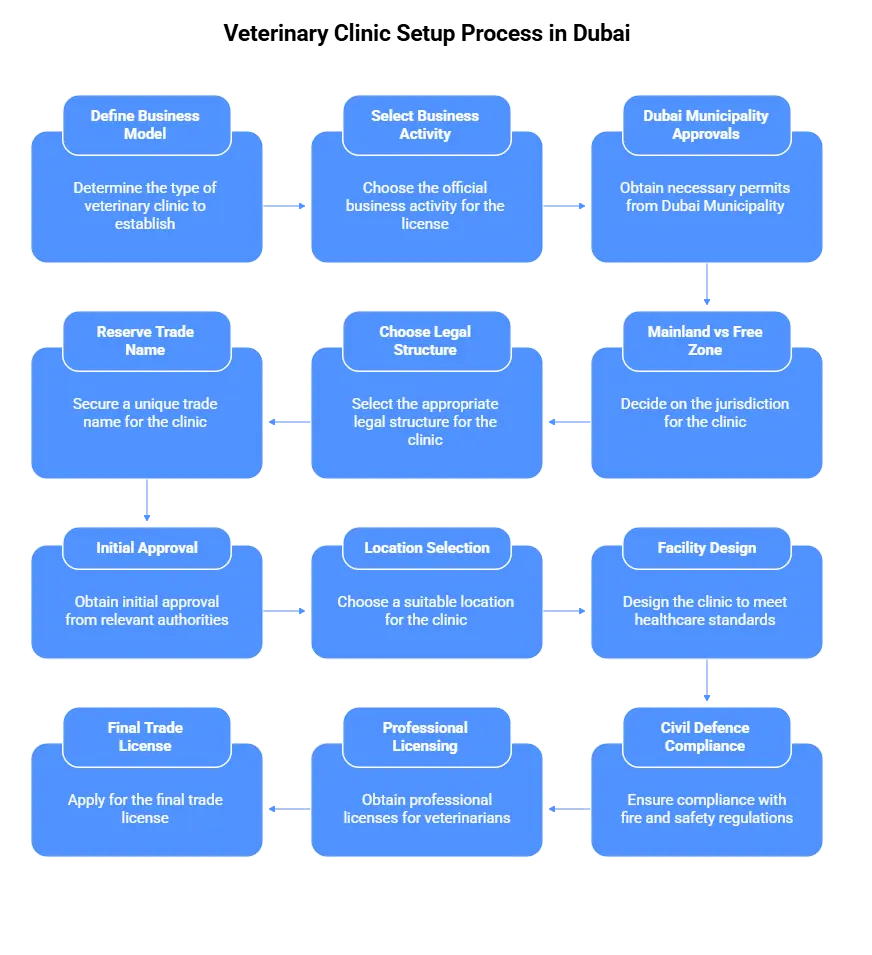
Step 1: Define Your Veterinary Business Model
Not all veterinary clinics are the same.
Before applying for any license, define your model:
- General Veterinary Clinic
Routine checkups, vaccinations, diagnostics, and minor surgeries.
- Specialized Animal Hospital
Orthopedic surgery, dermatology, dental surgery, and internal medicine.
- Exotic Pet Clinic
focus exclusively on routine checkups and preventive care for birds, reptiles, rabbits, and other small or rare species
- Mobile Veterinary Services
Home visits and emergency care.
- 24/7 Veterinary Hospital
Emergency and intensive care services.
Your chosen model will determine:
- Facility size
- Equipment requirements
- Staffing needs
- Investment level
- Regulatory category
Step 2: Select Your Business Activity
Once you’ve defined your veterinary business model, the next big step is choosing the official business activity that will appear on your trade license.
This is where many people get confused, because business model and business activity sound similar — but they’re definitely not the same.
Think of it this way:
- Your Business Model = the type of clinic you want to run (your concept)
- Your Business Activity = what the government officially permits you to do under your license
You’ll choose your business activity through:
- Dubai Department of Economy and Tourism (DET), if you’re setting up on the Mainland
- The respective Free Zone Authority, if you’re setting up inside a Free Zone
Your business model helps you decide which activity to choose — but the two cannot replace each other. For example, you might want to run a 24/7 animal hospital (business model), but your trade license must officially list “Veterinary Hospital” as the business activity.
Expert Tip: One of the most common reasons new clinics face approval delays is choosing the wrong activity. Selecting something too general (like “Veterinary Services”) when you actually need “Veterinary Hospital” can lead to rejections, redesigns, and weeks of lost time.
Step 3: Dubai Municipality Approvals
Before your clinic can move toward fit-out, inspection, or licensing, you must secure a set of approvals from Dubai Municipality (DM). These apply only to Mainland veterinary clinics. Free Zones conduct their own reviews and coordinate with regulators separately.
Think of DM as the authority that checks whether your clinic is safe, hygienic, and medically compliant before it opens its doors.
Within Dubai Municipality, the Public Health & Safety Department plays an important role in reviewing veterinary healthcare facilities. This department evaluates sanitation standards, infection control protocols, ventilation systems, sterilization processes, and medical waste handling to ensure that veterinary clinics operate safely and meet public health regulations.
What Dubai Municipality Approves:
DM issues several mandatory permits and clearances:
✔ 1. DM Veterinary Establishment Operating Permit
Confirms your clinic is allowed to operate as an animal healthcare facility on the Mainland.
✔ 2. DM Public Health & Safety Approval
Covers infection control, sterilization flow, ventilation, and hygiene standards.
✔ 3. DM-Approved Medical Waste Disposal Contract
You must have a contract with a DM-approved medical waste provider before opening.
✔ 4. DM Water & Drainage Compliance
DM checks drainage slopes, wet areas, sinks, and plumbing for surgery, labs, and grooming.
✔ 5. DM Radiology Room Approval (if applicable)
If you install X-ray equipment, DM reviews shielding, wall thickness, and layout.
✔ 6. DM Final Pre-Opening Inspection & Operating Clearance
Before your trade license is issued, DM conducts a physical inspection to verify:
Facility layout
Equipment installation
Hygiene & infection control
Medical waste processes
Clean/dirty workflow
Ventilation and isolation rooms
Once you pass this inspection, DM issues the final clearance needed for the Mainland license. All applications are submitted through the Dubai Municipality smart portal or via a licensed business setup consultant who handles the coordination.
Step 4: Mainland vs Free Zone – What’s Allowed?
One of the most common questions when planning a Veterinary clinic in the UAE is whether to choose the Mainland or Free Zone jurisdiction. The answer depends on your target market, operational model, and the specific free zone regulations.
Mainland Setup
A mainland veterinary clinic is licensed through the Dubai Department of Economy and Tourism and regulated by Dubai Municipality.
Advantages:
- Direct access to the entire UAE market
- Ability to open in residential communities (Jumeirah, Marina, Mirdif, etc.)
- No geographic restrictions within Dubai
- Easier retail visibility for walk-in pet owners
Mainland is typically preferred for community-based veterinary clinics and high-visibility retail locations.
Free Zone Setup
Certain free zones may allow veterinary or healthcare-related activities, subject to their internal regulations and coordination with external authorities such as:
- Ministry of Climate Change and Environment
- Relevant veterinary regulatory bodies
- Free zone authority’s own inspection and compliance department
Free zones such as Dubai Silicon Oasis or Dubai Multi Commodities Centre conduct their own facility inspections and compliance approvals in coordination with government regulators.
However, practical considerations apply:
- Some free zones are commercial or industrial-focused and may not approve public-facing clinical facilities.
- Zoning restrictions may limit walk-in patient access.
- Additional coordination with federal veterinary licensing authorities is still mandatory.
Step 5: Choose Legal Structure
When starting a veterinary care centre, most investors choose a Limited Liability Company (LLC). An LLC offers liability protection, full access to the UAE market, staff visa eligibility, and a smooth corporate bank account setup. Thanks to recent reforms, 100% foreign ownership is permitted for veterinary activities, subject to regulatory approval.
In the Mainland, an LLC allows you to operate freely across Dubai. In a Free Zone, you can form an FZ-LLC with full ownership, but operations depend on zone-specific healthcare regulations and approvals.
Step 6: Reserve Trade Name
Your veterinary clinic in Dubai must have a trade name that:
- Is unique and not already registered
- Reflects the medical/veterinary nature of the activity
- Avoids religious, political, or offensive terms
- Complies with UAE commercial naming guidelines
For Mainland companies, trade name reservations are handled by the Dubai Department of Economy and Tourism (DET). Approval time is usually within 1–2 working days.
For Free Zone companies, the trade name is reserved directly through the respective Free Zone authority. Each zone has its own internal naming compliance rules. Approval time typically is 1–3 working days, depending on the zone.
Before license issuance, you can usually modify or reapply for a new trade name with minimal fees. After license issuance, a formal amendment process is required, including payment of government fees and updating documents (license, bank, contracts, visas).
Strategic advice: Finalise your brand name early to avoid administrative costs and delays later in the setup process.
Step 7: Initial Approval from Authorities
After reserving your trade name, your clinic in Dubai must obtain initial approvals — but the process differs between the Mainland and Free Zones.
On the Mainland, you apply to the Dubai Department of Economy and Tourism, followed by activity and facility approval from Dubai Municipality, which reviews your:
- Proposed services
- Clinic layout plan
- Equipment list
- Veterinarian qualifications
In Free Zones, the authority conducts its own pre-approval and coordinates with relevant regulators. It is required to ensure animal safety and compliance. It typically takes 2–4 weeks, depending on documentation and inspection readiness.
Step 8: Location Selection
Choosing the right location for your clinic directly affects visibility, footfall, and long-term profitability. High-pet-density areas like Jumeirah, Arabian Ranches, Dubai Marina, Mirdif, and Al Barsha are popular because villa communities and expat families actively seek pet healthcare services nearby.
Convenience drives repeat visits for vaccinations, checkups, and grooming referrals. When selecting a space, consider parking, accessibility, and proximity to pet stores. Avoid industrial zones unless operating a specialized veterinary hospital that requires larger facilities.
Step 9: Facility Design Requirements
Designing a veterinary clinic is not like setting up a retail shop — it must meet healthcare compliance standards. It is crucial to ensure animal safety, hygiene, and legal compliance before operations start.
What’s Required?
No matter where you set up — Mainland or Free Zone — the core facility requirements are almost the same. This typically includes:
- Separate consultation rooms
- A dedicated surgery room (if your model includes surgeries)
- Sterilization and laboratory areas
- An isolation room for contagious or infectious animals
- Pharmacy and medication storage
- Medical waste disposal system
- Proper ventilation and hygiene controls
These requirements are based on animal safety and healthcare guidelines and apply across all jurisdictions.
On the Mainland, Dubai Municipality reviews and approves the layout before fit-out begins. They assess infection control, drainage systems, medical waste flow, and radiation shielding (if applicable) before granting fit-out permission.
Dubai Municipality also enforces strict biosecurity standards. Your clinic must include proper animal handling protocols, quarantine measures, controlled ventilation, and sterilization systems to prevent cross-infection between species.
In Free Zones, the authority conducts inspections and coordinates with external regulators to ensure your design meets veterinary healthcare standards.
Expert Tip: Never design your veterinary clinic based only on aesthetics or contractor advice. Always align your architectural drawings with regulatory standards before signing the fit-out contract. A pre-approval consultation with authorities can save months of delay and thousands in redesign costs. In Dubai’s healthcare licensing environment, compliance-driven design is the smartest investment you can make- Essa Al Harthi, CEO, Best Solution.
Step 10: Public Safety Department Compliance
In Dubai, starting a veterinary clinic requires approval from the Public Safety Department to ensure the facility meets all health, safety, and fire protection standards. This approval is necessary because veterinary clinics handle animals, medical procedures, and potentially hazardous waste, so the facility must comply with regulations for fire safety, emergency preparedness, sanitation, waste disposal, and safe animal handling. The process involves preparing the clinic according to these standards, submitting an application to the Public Safety Department (often coordinated with Dubai Civil Defence), and passing an on-site inspection to verify compliance with safety codes.
Only after this approval is issued can the clinic obtain its commercial license from the Department of Economic Development (DED). Many clinic owners engage a licensed safety consultant to ensure all requirements are met before inspection, which helps streamline the process and avoid delays.
Real Client Incident: Public safety Clearance Delay
One of our clients, “We Care Veterinary Clinic”, contacted us after their veterinary clinic in Dubai was ready for launch, but couldn’t receive final approval. The issue was with fire safety compliance under Dubai Civil Defence.
They completed a high-quality fit-out but installed residential-grade smoke detectors rather than approved commercial fire alarm systems. Emergency exit signage was not illuminated, and the fire alarm system was not connected to a certified monitoring company.
During the inspection, Civil Defence rejected the application.
The consequences?
- Mandatory system replacement
- Additional contractor charges
- Re-inspection fees
- 5-week operational delay
When they approached us, we coordinated with a Civil Defence-approved fire contractor, upgraded the system to comply with the relevant standards, ensured proper documentation (AMC contract, drawings, test certificates), and scheduled a pre-inspection.
On re-application, clearance was granted without objections.
Lesson: In a veterinary clinic setup in the UAE, even small fire safety deviations can delay license issuance. Compliance must match Civil Defence standards from day one.
Based on the “We Care Veterinary Clinic” incident, here is a professional checklist to ensure your facility meets Dubai Civil Defence (DCD) standards before your final inspection. Using this proactively will save you from the “5-week delay” mentioned in the case study.
| Category | Requirement | Critical Detail |
|---|---|---|
| Global Branding | High Prestige | Massive overhead; requires a serious marketing budget. |
| Alarm Connectivity | 24/7 Monitoring | The system must be connected to the Hassantuk (24/7 Smart Monitoring) system via an approved provider. |
| Emergency Signage | Illuminated Exits | All exit signs must be internally illuminated (battery-backed) and visible even during a power outage. |
| Fire Suppression | Portable Extinguishers | Specific types (CO2 for electrical, Powder for general) must be mounted at regulated heights with valid tags. |
| Documentation | The "Gold" Folder | You must have an Annual Maintenance Contract (AMC) with a DCD-approved contractor and a "Civil Defense Completion Certificate." |
| Architectural | Fire-Rated Doors | Surgery rooms and storage areas for medical gases (oxygen) often require fire-rated doors (60-120 mins). |
Step 11: Professional Licensing for Veterinarians
When setting up a veterinary clinic, professional licensing is one of the most critical steps. Every practising veterinarian must obtain approval from the Ministry of Climate Change and Environment (MOCCAE) before legally treating animals.
What do they need?
1️⃣ Recognised Veterinary Degree
A bachelor’s degree in veterinary medicine (or equivalent) from an accredited university.
2️⃣ Relevant Work Experience
Usually 2+ years of clinical experience (may vary depending on role and specialization).
3️⃣ Good Standing Certificate
Issued by the veterinary regulatory authority in the country where they last practiced.
4️⃣ License Verification
Verification of previous professional license (if already licensed elsewhere).
5️⃣ Passport & Valid UAE Visa
Required for identity and residency compliance.
6️⃣ MOCCAE Approval
Professional licensing from the Ministry of Climate Change and Environment.
Whether your pet clinic operates on the Mainland or in a Free Zone, MOCCAE approval remains mandatory, as veterinary healthcare is federally regulated. Without licensed veterinarians, your animal clinic cannot legally offer consultations, vaccinations, prescriptions, or surgeries, making this approval essential for compliance and long-term credibility.
Expert Tip: “Most delays in veterinary clinic setup happen at the professional licensing stage. We’ve seen cases where degree attestation or Good Standing verification was overlooked, causing weeks of delay. Our advice is simple: start the MOCCAE licensing process parallel to your trade license application. Early document verification prevents last-minute surprises and protects your clinic’s launch timeline.”- Vipin Kumar, General Manager, Best Solution.
Step 12: Apply for Final Trade License
Once your veterinary clinic secures facility approval, fire safety clearance, and a registered tenancy contract, you can apply for the final trade license. For Mainland clinics, submit the application online through the Dubai Department of Economy and Tourism portal after obtaining approval from Dubai Municipality and Dubai Civil Defence. Mainland license issuance typically takes 3–7 working days after all approvals (Municipality, Civil Defence, MOCCAE) are completed and fees are paid. Delays usually happen if external approvals are pending.
Required documents include:
- Initial approval certificate
- Trade name reservation
- MOA / LSA agreement (if applicable)
- Ejari-registered tenancy contract
- Passport copies of shareholders
- External approvals from Dubai Municipality
- Clearance from Dubai Civil Defence
- Veterinarian approval from the Ministry of Climate Change and Environment
In Free Zones, apply directly through the respective authority’s portal with a lease agreement, approvals, and professional permits.
You usually need the documents:
- Trade name approval from the Free Zone authority
- Shareholder documents (passport, visa, NOC if required)
- Lease agreement within the Free Zone
- Business plan (in some zones)
- External veterinary approval (MOCCAE)
License issuance can take 2–5 working days in many zones. However, if coordination with federal regulators, such as the Ministry of Climate Change and Environment, is required, timelines may be extended.
When launching a veterinary clinic, your medical equipment isn’t just operational—it’s a core compliance requirement. Before approvals are granted, authorities will review your declared equipment list against your clinic layout. A standard setup typically includes examination tables, surgical lighting, digital X-ray machines, ultrasound systems, anaesthesia units, laboratory analysers, and temperature-controlled vaccine refrigerators.
For Mainland clinics licensed through the Dubai Department of Economy and Tourism, equipment details are reviewed alongside approvals from Dubai Municipality. In both Mainland and Free Zone setups, veterinary facilities must also align with federal standards and, where required, comply with professional regulations under the Ministry of Climate Change and Environment.
Sourcing is equally critical. Always purchase from UAE-registered medical suppliers that comply with federal medical device import regulations. While compliance standards remain consistent across jurisdictions, some Free Zones conduct additional internal inspections before granting operational clearance—so preparation is key.
Operating a Veterinary Clinic in Dubai: Compliance After Licensing
Obtaining your veterinary clinic license is a major milestone, but maintaining compliance is equally important once your clinic begins operations. Veterinary facilities must follow ongoing regulatory requirements to ensure animal welfare, public health, and professional standards.
Authorities such as Dubai Municipality, Dubai Civil Defence, and the Ministry of Climate Change and Environment may conduct periodic inspections to ensure clinics continue to meet hygiene, safety, and veterinary care standards.
Key responsibilities after licensing include:
1. Annual Trade License Renewal
Veterinary clinics must renew their trade license every year through the Dubai Department of Economy and Tourism or the relevant Free Zone authority. Renewal typically requires a valid tenancy contract, updated regulatory approvals, and payment of government renewal fees.
2.Veterinarian License Maintenance
Every practising veterinarian must maintain an active professional license issued by the Ministry of Climate Change and Environment. Without licensed veterinarians on staff, a veterinary clinic in Dubai cannot legally provide consultations, diagnostics, or treatments.
3.Medical Waste Disposal Compliance
Veterinary clinics must maintain a contract with an approved medical waste disposal provider to ensure the safe handling and disposal of biological and pharmaceutical waste in accordance with municipal regulations enforced by Dubai Municipality. Clinics should store veterinary waste in certified biohazard containers and maintain proper disposal records for regulatory inspections.
4.Equipment Maintenance and Safety Checks
Medical equipment such as X-ray machines, laboratory analysers, and anaesthesia units should be regularly serviced and calibrated to ensure safe and accurate veterinary diagnostics.
By maintaining these operational standards, veterinary clinics can ensure continuous compliance, protect animal health, and build trust with pet owners in Dubai’s growing pet care market.
Understanding Veterinary Clinic License Costs in Dubai
If you’re planning to start a Veterinary clinic, one of the first questions you’ll ask is: How much does the trade license cost? Let’s break it down clearly.
For a Mainland veterinary clinic, the trade license typically ranges between AED 15,000 and AED 25,000. This gives you full UAE market access and allows you to operate anywhere in Dubai, subject to approvals from Dubai Municipality and the Ministry of Climate Change and Environment.
For a Free Zone veterinary clinic, the initial trade license costs generally range from AED 10,000 to AED 18,000, depending on the specific Free Zone and the veterinary activity category. This is the one-time license issuance cost only, and does not include visas, facility approvals, or clinic setup expenses.
So, what does this mean for you? The license fee is only one part of the total cost of setting up a veterinary clinic in Dubai. Your final investment will depend on clinic size, location, fit-out standards, equipment, and staffing requirements.
In short, while license costs are predictable, the overall budget varies depending on your business model and jurisdiction.
Final Thoughts: Building Trust Beyond Business
Opening a veterinary clinic in Dubai isn’t just another business project — it’s a commitment to a community that treats pets as family. And when you enter this industry, you’re not only offering medical services; you’re providing comfort, safety, and trust.
When you combine:
- Proper licensing and compliance
- Ethical veterinary practices
- High-quality equipment and technology
- Transparent, honest pricing
- A strong online presence that reassures pet owners
…you don’t just open a clinic — you build a brand people rely on.
The pet care sector in Dubai is growing rapidly, but the clinics that truly thrive are the ones that operate with structure, compassion, and professionalism. When your clinic is compliant, well-designed, and staffed by licensed professionals, pet owners feel confident entrusting their animals to your care.
If you follow the right roadmap, secure approvals in the correct order, and work with experts who understand the regulatory landscape, your journey from idea to fully operational veterinary clinic becomes smoother, faster, and far more rewarding.
At the end of the day, your success isn’t just measured by revenue — it’s measured by pets’ health and every grateful family that walks through your doors.
Frequently Asked Questions
What licenses do I need to start a Veterinary clinic in Dubai?
To legally open a veterinary clinic, you need a trade license from the Dubai Department of Economy and Tourism or relevant Free Zone authority, facility approval from Dubai Municipality, and a veterinary establishment license from the Ministry of Climate Change and Environment. Veterinarians must also hold professional MOCCAE licenses.
How long does it take to get a Veterinary clinic license in Dubai?
The full process usually takes 4–8 weeks: initial approvals (1–2 weeks), fit-out and facility inspection (2–4 weeks), and final trade license issuance (3–7 working days). Timelines may vary by jurisdiction and completeness of documents.
Can a foreign investor own 100% of a Veterinary clinic in Dubai?
Yes. Thanks to UAE company law reforms, foreign investors can have 100% ownership in most business structures, including veterinary clinics, particularly within Free Zones, subject to regulatory approvals.
Do I need professional licensing for veterinarians working in my clinic?
Absolutely. Every practising veterinarian must obtain a professional license from MOCCAE, demonstrating recognised qualifications and experience. Without this, the clinic cannot legally offer consultations, diagnostics, or treatments.
Can I start a Veterinary clinic in a Free Zone?
Yes — certain Free Zones allow veterinary or healthcare-related activities if the zone authority approves and coordinates with federal regulators. However, clinical operations must meet specific facility, zoning, and professional licensing standards.
Are there zoning or location requirements for a Veterinary clinic?
Your clinic must be in a compliant commercial or healthcare-permitted area. Residential communities with high furry friend populations (e.g., Jumeirah, Al Barsha) deliver better footfall for walk-in services, while industrial zones may not be suitable for public clinics.
Do Veterinary clinic licenses need annual renewal in Dubai?
Yes — trade licenses, establishment licenses, facility approvals, and individual veterinarian professional licenses generally require annual renewal to remain valid and compliant.
References
- UAE pet care industry expand
- Federal Decree-Law on Veterinary Medical Products and Veterinary Pharmaceutical Establishments
- Issue a license for practicing animal care
Disclaimer : This guide provides a general information . Regulations and costs may change time to time based on government rules, so consult the best solution’s professional Business Setup consultants for the latest updates. Refer to the glossary for definitions of key terms which is mentioned in this article. Refer to the glossary for definitions of key terms.