Dubai has transformed itself into one of the world’s most strategic logistics and trade gateways. Positioned between Europe, Asia, and Africa, Dubai connects global supply chains through advanced infrastructure, smart ports, and investor-friendly regulations. From the massive cargo capacity of Jebel Ali Port, operated by DP World, to the aviation network at Al Maktoum International Airport, the emirate has built a powerful ecosystem for freight forwarding, warehousing, and transportation services.
For entrepreneurs, starting a Logistics Company in Dubai means entering a fast-growing industry driven by e-commerce fulfilment, global trade, supply chain management, and cross-border shipping. Strategic hubs like Dubai Logistics City make it easier for businesses to manage distribution, storage, and international cargo movement efficiently.
However, launching a logistics startup involves more than trucks and warehouses. From choosing the right license to selecting between mainland and free zone setups, every decision shapes your success. This guide explains the full process step by step.
Why Dubai is the Perfect Place to Start a Logistics Company
Dubai has built its reputation as a global trade gateway. Several factors make it one of the most attractive places to start a logistics company. The city offers a strategic location between major global markets, advanced infrastructure, and a highly supportive business environment. These advantages have helped transform the emirate into a global hub for freight forwarding, cargo handling, warehousing, and supply chain management.
Strategic Location
Dubai, between Europe, Asia, and Africa, serves as a key international logistics hub. Businesses can move cargo to major markets with short transit times:
Goods can reach:
- Europe in 8 hours
- Asia in 6 hours
- Africa in 5 hours
This positioning helps logistics providers efficiently manage cross-border shipping, freight consolidation, and regional distribution, offering direct access to fast-growing markets.
World-Class Ports and Airports
Dubai is home to an advanced logistics infrastructure. Jebel Ali Port, operated by DP World, is one of the largest container ports in the world and plays a crucial role in maritime trade.
On the aviation side, Al Maktoum International Airport and Dubai International Airport support large cargo operations, enabling seamless sea-air logistics.
E-Commerce Boom
The rapid expansion of e-commerce in the United Arab Emirates and the wider Middle East has significantly increased demand for logistics services. Online platforms such as:
- Amazon UAE
- Noon
- Talabat
- Careem
have created massive demand for last-mile delivery services and warehouse logistics. This trend creates excellent opportunities for new entrants in the logistics sector.
Business-Friendly Environment
Dubai’s pro-business policies also make it easier to establish and scale a logistics venture. Dubai offers:
- 100% foreign ownership in many sectors
- Zero personal income tax
- Easy company formation
- Access to global markets
For startups and investors, these advantages lower operational barriers and foster long-term growth in global logistics.
Starting a Logistics Business in Dubai: Licensing, Costs, and Process
To start your logistics company, follow the legal and operational steps below in the order listed.
Let’s break them down.
Step 1: Conduct Market Research
First, research and assess the demand for logistics services in Dubai before committing any investment.
Key questions to ask:
- Which logistics service is most profitable?
- Who are your competitors?
- What industries need logistics services?
Popular industries needing logistics services include:
- E-commerce
- Retail
- Manufacturing
- Construction
- Food import/export
Once you identify your target market, use your findings to select a specific logistics niche for your business.
Step 2: Choose the Right Business Activity
Every company registered in Dubai must choose specific activities that clearly define the services it will provide. These activities are approved by the relevant authority, such as the Dubai Department of Economy and Tourism for mainland companies or the respective free zone authority.
Common logistics-related activities include:
- Freight forwarding services
- Cargo packaging services
- Warehousing and storage services
- Courier and delivery services
- Transport of goods by road
Choosing the correct activity is essential because it determines what operations your company can legally perform, what approvals are required, and whether additional permits are needed from authorities such as Dubai Customs or the Roads and Transport Authority.
Expert Tip: Many logistics startups choose only one activity to reduce initial costs. However, if you plan to expand into warehousing, freight forwarding, or distribution later, selecting multiple relevant activities during registration can help avoid costly license amendments in the future- Essa Al Harthi, CEO, Best Solution Business Setup Consultancy.
Step 3: Select the Best Business Jurisdiction
Then, choose whether to register your company on the mainland or in a free zone. Evaluate this based on your target market and desired business operations.
Mainland Company
Advantages:
- Work directly with UAE clients.
- No trade restrictions
- Government contracts possible
However, regulations may be slightly stricter. Mainland business licenses are issued by the Dubai Department of Economy and Tourism.
Free Zone Company
Popular logistics free zones include:
- JAFZA
- Dubai South
- Dubai Airport Free Zone
Benefits include:
- 100% foreign ownership
- Tax benefits
- Simplified customs procedures
For international logistics operations, free zones are often the best choice. Free zone companies are licensed by the individual free zone authority where the business is established.
Choosing the right jurisdiction will influence your market access, operational flexibility, and regulatory requirements, so it’s an important step when setting up a logistics business in Dubai.
Step 4: Select Legal Structure
After selecting the jurisdiction, the next step in setting up a logistics business is choosing the appropriate legal structure. Your legal form determines ownership, liability, and operational flexibility. For mainland companies licensed by the Dubai Department of Economy and Tourism, the most common structure is a Limited Liability Company (LLC). In free zones such as Jebel Ali Free Zone, businesses can register as a Free Zone Establishment (FZE) or Free Zone Company (FZCO). Selecting the right structure ensures legal protection and supports the long-term growth of your logistics business.
Step 5: Choose a company name
Selecting the right trade name is a critical step when setting up a company in Dubai. Your company name is not just a legal requirement—it becomes your brand identity in the UAE logistics market, especially when working with clients in freight forwarding, cargo transport, warehousing, and supply chain management.
Your trade name must:
- Be unique and not already registered.
- Reflect the logistics, cargo, freight, or transportation nature of your business.
- Avoid religious, political, or offensive words.
- Follow UAE commercial naming guidelines.
For Mainland companies, reserve your trade name through the Dubai Department of Economy and Tourism, which usually approves in 1–2 days.
For Free Zone companies, reserve through the specific free zone authority. Approval typically takes 1–3 days.
You can change the trade name before getting your license for a small fee. After license issuance, changes require formal amendments.
Expert tip: Pick a name that aligns with your logistics services and future growth to avoid rebranding later.
Step 6: Initial Approval
When starting a company in Dubai, obtaining initial approval is an important regulatory step. This approval confirms that the government has no objection to your logistics business activities, including freight forwarding, cargo transport, or supply chain services.
For Mainland companies, the Dubai Department of Economy and Tourism reviews stakeholder documents and logistics activities. This takes 1–3 days.
Free Zone approvals are handled by the free zone authority and take 2–5 days, depending on license and compliance checks.
Step 7: Prepare Legal Documents (MOA / Incorporation Documents)
After initial approval, submit legal incorporation documents to the authorities.
For Mainland companies, this includes:
- Memorandum of Association (MOA)
- Shareholder agreement
- Manager appointment document
For Free Zone companies, the Free Zone Authority prepares similar incorporation documents.
These documents define:
- Ownership structure
- Profit distribution
- Operational responsibilities
This step usually takes 1–3 working days once the documents are submitted. Mainland companies may require notarization of legal documents, whereas Free Zone authorities typically handle incorporation internally.

Step 8: Identify the Right Location
Choosing the right location is a key step in establishing a logistics business in Dubai, as proximity to ports, airports, and highways directly affects delivery speed, transportation costs, and overall supply chain efficiency. When selecting a location, consider factors such as warehouse space, truck access, cargo-handling facilities, and connectivity to major trade routes.
For Mainland logistics companies, industrial areas such as Dubai Investment Park are commonly used for warehouses and transport hubs. For Free Zone companies, logistics clusters like Jebel Ali Free Zone offer integrated warehousing and customs support. Location approval typically takes 2–5 working days during the licensing process.
Step 9: Set Up Office and Warehouse
Setting up the right office and warehouse infrastructure is an essential step when establishing a Logistics Company in Dubai. Logistics operations depend heavily on efficient storage, cargo handling, fleet movement, and transportation connectivity. When selecting a facility, businesses should evaluate factors such as warehouse capacity, truck parking space, loading docks, security systems, and proximity to major ports, airports, and highways.
For Mainland logistics companies, office and warehouse facilities are usually leased in industrial areas and must be registered with the Dubai Department of Economy and Tourism through an Ejari tenancy contract.
For Free Zone companies, logistics hubs such as Jebel Ali Free Zone offer integrated warehouse facilities, customs support, and freight infrastructure.
When setting up your facility, consider the following:
Office Workspace
- Close to warehouses and transport routes.
- Space for operations, dispatch, and customer service teams
- Reliable communication and internet systems
Warehouse or Storage Facility
- Adequate storage capacity and scalability
- High ceilings, shelving systems, and security monitoring
- Proximity to cargo hubs such as Jebel Ali Port
Vehicle Parking
- Sufficient space for trucks and delivery vans
- Easy entry and exit for large vehicles
- Compliance with fleet regulations from the Roads and Transport Authority
Loading and Unloading Areas
- Proper loading docks for trucks and containers
- Space for forklifts and cargo equipment
- Safe and efficient cargo movement zones
Facility approval and lease registration usually take 2–5 working days, depending on the documentation and the availability of locations.
Step 10: Obtain External Approvals
For many logistics businesses, external regulatory approvals are required before the final license is issued. These approvals ensure that your Logistics Company in Dubai can legally manage cargo transportation, freight forwarding, warehousing, and international trade operations.
For Mainland companies, approvals may be required from the Roads and Transport Authority if your business operates trucks, delivery vans, or cargo transport vehicles. Businesses involved in import or export shipments must also register with Dubai Customs. The approval process typically takes 3–7 working days, depending on the logistics activities and compliance requirements.
Step 11: Submit Final Documents and Receive License
Once all approvals are complete, the final step is submitting the required documents for your logistics trade license. These typically include the trade name certificate, initial approval, Memorandum of Association (MOA), warehouse or office lease agreement, and any external approvals.
For Mainland companies, documents are submitted to the Dubai Department of Economy and Tourism, where authorities verify business activities such as freight forwarding, cargo transport, and warehousing.
For the Free Zone, the process is handled directly by authorities like Jebel Ali Free Zone. They review compliance, facility requirements, and shareholder details.
Once verified, the logistics license is issued within 1–3 working days, allowing your company to legally operate logistics and supply chain services in Dubai.
Post-License Requirements for Logistics Company
After obtaining your logistics company trade license, businesses must complete a few operational steps before launching services. This typically includes purchasing vehicles, hiring logistics staff, and implementing warehouse and fleet management systems. These post-license requirements ensure your cargo transportation, freight forwarding, and supply chain operations run smoothly from the start.
1. Transport Permits
If your logistics company operates delivery vans, trucks, or cargo transport vehicles, approval from the Roads and Transport Authority may be required. This ensures:
- Vehicle compliance
- Proper driver licensing
- Fleet safety standards
2. Customs Registration
Companies handling freight forwarding or international cargo shipments must register with Dubai Customs. This allows your business to:
- Clear shipments
- Handle cargo documentation
- Manage international logistics operations.
3. Import–Export Code
Businesses involved in global trade, cargo forwarding, or supply chain services may also require an import–export registration linked to customs systems. This enables:
- Shipment declarations
- Cargo tracking
- Customs clearance procedures
4. Warehousing Approval
If your logistics company operates storage facilities, additional warehouse approvals may be required depending on the location and jurisdiction.
For Free Zone logistics companies, especially in hubs like Jebel Ali Free Zone, many approvals are coordinated internally with customs and port authorities. Because of this integrated system, approval timelines are usually faster, typically 2–5 working days.
5. Hire Skilled Staff
Hiring the right team is crucial for the success of your Logistics Company in Dubai. Logistics operations encompass cargo handling, transportation management, warehousing, and customer coordination, making skilled professionals essential to maintaining efficiency and reliability in the supply chain.
Typical roles include:
1.Logistics Manager
Responsible for overseeing shipping operations, freight coordination, warehouse management, and supply chain planning.
- Bachelor’s degree in logistics, supply chain management, or business administration
- 3–5 years of experience in freight forwarding, cargo operations, or logistics management
- Knowledge of shipping documentation and coordination with authorities such as Dubai Customs
2. Delivery Drivers
- Drivers manage cargo transportation and last-mile deliveries.
- Valid UAE commercial driving license approved by the Roads and Transport Authority
- Experience in delivery or cargo transport operations
- Familiarity with UAE road regulations and logistics routes
3. Warehouse Staff
Warehouse teams handle inventory storage, cargo loading, and order fulfilment.
- Experience in inventory handling and warehouse operations
- Training in forklift operation, pallet handling, and safety procedures
- Ability to manage stock systems and cargo documentation
4.Customer Service Representatives
Responsible for managing client communication, shipment tracking, and logistics documentation.
- Diploma or bachelor’s degree in business administration, logistics, or supply chain management
- 1–3 years of experience in logistics coordination or customer support
- Knowledge of shipment tracking systems and cargo documentation with authorities like Dubai Customs
- Strong communication and problem-solving skills
5.Operations Manager
Oversees daily logistics operations, including fleet management, warehouse coordination, and delivery performance.
- Bachelor’s degree in logistics, supply chain management, or business management
- 5+ years of experience in logistics operations or freight forwarding
- Knowledge of logistics regulations from the Roads and Transport Authority
- Strong leadership and operational planning skills
These qualification requirements are generally the same for both Mainland and Free Zone logistics companies.
For Mainland companies, employee visas and labour approvals are processed through the Ministry of Human Resources and Emiratisation, while Free Zone companies obtain staff permits through their respective free zone authority. Work permit approvals usually take 3–7 working days, depending on documentation and visa processing requirements.
6: Implement Logistics Technology
Implementing the right technology is essential for running a successful logistics business in Dubai. Modern logistics operations depend on digital systems to efficiently manage cargo movement, warehouse inventory, and fleet operations. Common tools include warehouse management systems (WMS), fleet tracking software, inventory management platforms, and delivery route optimization tools.
These technologies help logistics businesses track shipments in real time, reduce operational costs, improve delivery speed, and enhance supply chain visibility. When selecting logistics software, companies should consider system integration, scalability, data security, and compatibility with warehouse operations.
Unlike licensing steps, technology implementation usually does not require government approval. However, fleet tracking systems should comply with the guidelines issued by the Roads and Transport Authority. Both Mainland and Free Zone logistics companies can adopt these systems to improve operational efficiency and customer service.
7: Purchase Vehicles and Logistics Equipment
Once your infrastructure is ready, the next step in setting up a Logistics Company in Dubai is to purchase or lease the appropriate transportation vehicles and warehouse equipment. The type of equipment you need depends on your logistics services, such as freight forwarding, cargo transportation, warehousing, or last-mile delivery. Common assets include delivery vans, cargo trucks, forklifts, pallet jacks, and warehouse shelving systems.
For the Mainland, commercial vehicles must be registered and approved by the Roads and Transport Authority. Authorities check:
- Vehicle specifications
- Safety standards
- Driver licensing
- Fleet compliance.
Vehicle registration and operational approval typically take 2–4 working days.
For Free Zone logistics companies, fleets operating within logistics hubs may follow internal fleet and warehouse equipment regulations coordinated with customs and port authorities.
When purchasing equipment, consider vehicle capacity, fuel efficiency, maintenance costs, compatibility with warehouse layout, and scalability. Many startups choose vehicle leasing or fleet partnerships initially to reduce capital investment while building logistics operations.
8: Vehicle Registration and Fleet Permits
For a logistics company, registering transport vehicles is essential before starting cargo delivery or freight transportation services. For Mainland companies, all delivery vans and cargo trucks must be registered with the Roads and Transport Authority.
The authority verifies vehicle specifications, safety standards, commercial plates, and driver licensing to ensure fleet compliance with UAE transport regulations. Logistics companies operating fleets for last-mile delivery, cargo transport, or freight forwarding must also maintain proper fleet documentation and vehicle insurance.
In the Free Zone, fleets operating within logistics hubs like Jebel Ali Free Zone may follow internal fleet regulations coordinated with port and customs authorities. Approval and vehicle registration generally take 2–4 working days, depending on documentation and inspection requirements.
9: Employee Visas and Labour Cards
Hiring staff is a key operational requirement after establishing a logistics business. For Mainland companies, employee visas, labour contracts, and work permits are processed through the Ministry of Human Resources and Emiratisation. Authorities verify employment contracts, job roles, passport documents, and company license details before issuing labour cards and residence visas. The entire process typically takes 7–10 working days,
Logistics businesses typically sponsor drivers, warehouse staff, logistics managers, and operations personnel under their company visa quota. For Free Zone companies, employee permits and visas are handled directly by the relevant Free Zone authority, which manages immigration coordination and internal labour approvals. Visa processing timelines generally range from 5 to 7 working days, depending on documentation, medical tests, and Emirates ID registration requirements.
10: Corporate Bank Account Opening
Opening a corporate bank account in Dubai is essential for managing payments, supplier transactions, payroll, and logistics contracts. Both Mainland and Free Zone logistics companies must submit documents such as the trade license, incorporation documents, shareholder passports, and company registration certificates when applying to UAE banks.
Financial institutions review the company’s business activities, ownership structure, and compliance with anti-money laundering regulations before approving an account. Logistics businesses involved in freight forwarding, cargo handling, and supply chain services often require multi-currency banking facilities to manage international transactions. The process is generally the same for Mainland and Free Zone entities, although Free Zone companies may need additional authority letters from their zone. Account approval typically takes 5–10 working days, depending on the bank’s compliance checks.
11: Insurance Coverage for Logistics Operations
Insurance is a critical risk-management requirement for any logistics company, as its operations involve cargo transportation, warehousing, and fleet movement. Logistics businesses typically obtain vehicle insurance, cargo insurance, warehouse insurance, and liability coverage to protect goods, equipment, and employees.
For Mainland logistics companies, commercial vehicle insurance is mandatory when registering fleets with the Roads and Transport Authority. Warehouses may also require additional coverage depending on cargo type and storage facilities.
Free Zone logistics companies operating in hubs like Jebel Ali Free Zone often follow insurance guidelines set by the zone authority and port operators. Insurance policies help businesses manage risks related to cargo damage, transit losses, accidents, and operational liabilities.
Many entrepreneurs assume a trade license is a “green light” to start immediately. Mr Daniel Garcia of DKMT Logistics recently discovered that the sequence of setup is just as vital as the license itself.
A Costly Roadblock: Marco leased a 5,000 sq. ft. warehouse in Al Quoz, purchased three vans, and hired drivers. However, the RTA rejected his vehicle registration because his warehouse lacked the required loading bay dimensions and heavy-vehicle parking. Daniel faced a 45-day delay and losses of AED 40,000+.
At that time, he heard about us and approached us. We pivoted Daniel’s strategy immediately to halt the financial drain:
- 3PL Partnership: We facilitated a short-term agreement with an approved provider, allowing Daniel to fulfil contracts while his site was modified.
- “Split-Fleet” Strategy: We prioritized registering his smaller vans first, getting 50% of his team on the road in 7 days.
- Lease Mitigation: We leveraged a compliance clause to negotiate a 15-day rent-free period.
The Result: Daniel was operational within a week, reducing his projected losses by 75%. Don’t just get a license—get a strategic partner.
Cost of Starting a Logistics Company in Dubai
If you’re planning to start a logistics company in Dubai, one of the first questions that usually comes up is: “How much does the license cost?” The good news is that the logistics trade license cost in Dubai is relatively flexible and depends mainly on whether you choose a Mainland or Free Zone setup.
For Mainland logistics businesses, the license is issued by the Dubai Department of Economy and Tourism. The logistics company license cost in Dubai Mainland typically ranges from AED 15,000 to AED 25,000, depending on the selected activities, such as freight forwarding, cargo transportation, courier services, or supply chain operations.
For Free Zone companies, the license is issued by the authorities in logistics hubs such as Jebel Ali Free Zone or Dubai South. In most cases, the Free Zone logistics license costs start at around AED 12,000 and can reach AED 30,000, depending on the license package, visa eligibility, and facility options.
It’s important to remember that these figures cover only the logistics trade license. The total cost of starting a logistics company in Dubai will depend on several additional factors, such as office or warehouse space, fleet vehicles, employee visas, insurance, and logistics management software.
In simple terms, the license is just the starting point—your final investment will depend on the scale of your logistics operations, freight services, and supply chain infrastructure.
Need expert guidance?
You can also speak directly with our business setup consultants to understand the exact cost, licensing requirements, and best jurisdiction for your logistics company in Dubai.
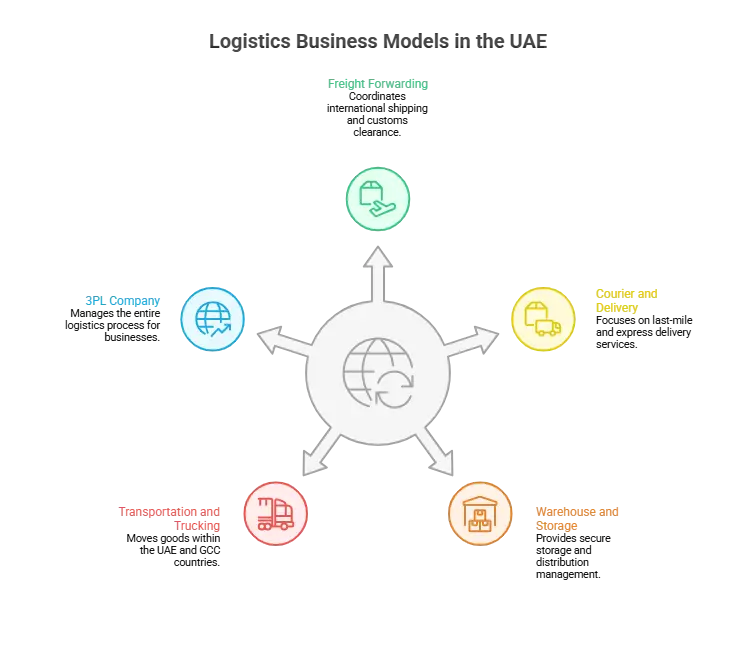
Choosing the right business model is crucial.
- Freight Forwarding Company
Freight forwarders coordinate international shipping using airlines, shipping lines, and trucking companies.
Services include:
- Cargo booking
- Shipping documentation
- Customs clearance
- Cargo insurance
This is one of the most profitable logistics business models.
- Courier and Delivery Company
With the rise of e-commerce, courier companies are booming.
These businesses focus on:
- Last-mile delivery
- Same-day delivery
- Express shipping
- Parcel distribution
You can partner with platforms like Amazon or Noon to get delivery contracts.
- Warehouse and Storage Company
Many companies need secure storage facilities for goods.
Warehouse logistics companies offer:
- Inventory storage
- Cold storage
- Distribution management
- Fulfillment services
This business is especially useful for e-commerce sellers and importers.
- Transportation and Trucking Company
Transportation companies move goods within the UAE or across GCC countries.
Services include:
- Cargo trucking
- Container transportation
- Construction logistics
- Heavy equipment transport
- 3PL (Third Party Logistics) Company
3PL companies manage the entire logistics process for businesses.
They provide:
- Warehousing
- Packaging
- Shipping
- Returns management
- Inventory tracking
Many e-commerce brands prefer working with 3PL providers instead of managing logistics themselves.
Final Thoughts
Starting a logistics company in Dubai can be a highly rewarding opportunity for entrepreneurs looking to enter the global logistics and supply chain industry. Thanks to its strategic location between Europe, Asia, and Africa, along with world-class infrastructure like Jebel Ali Port and operations led by DP World, Dubai has become a powerful hub for freight forwarding, cargo transport, warehousing, and international trade.
However, success in the Dubai logistics market requires careful planning. Entrepreneurs must choose the right logistics niche, understand market demand, build strong partnerships, and ensure compliance with regulations from authorities such as Dubai Customs. Investing in technology, route optimization, and efficient supply chain management can also improve operational performance.
Frequently Asked Questions
How much does it cost to start a logistics company in Dubai?
The logistics trade license in Dubai typically costs between AED 12,000 and AED 30,000, depending on whether the company is established in a mainland or a free zone. Additional costs may include warehouse rent, vehicles, visas, and insurance.
What license is required to start a logistics company in Dubai?
You need a logistics or freight forwarding trade license issued by the Dubai Department of Economy and Tourism for mainland companies or by a free zone authority such as JAFZA or Dubai South.
Can foreigners own a logistics company in Dubai?
Yes. Foreign investors can own 100% of a logistics company in Dubai through free zones or many mainland business activities.
Do logistics companies in Dubai need RTA approval?
Yes. Businesses operating delivery vans, trucks, or cargo transport fleets must obtain permits from the Roads and Transport Authority (RTA) before starting operations.
How long does it take to start a logistics company in Dubai?
If all documents and approvals are ready, the process usually takes 5–10 working days, depending on the jurisdiction and required regulatory approvals.
Which are the best free zones for logistics companies in Dubai?
Popular logistics free zones include Jebel Ali Free Zone (JAFZA), Dubai South, and Dubai Airport Free Zone, all of which offer infrastructure designed for cargo handling and international trade.
Do license costs differ for Air Freight vs Sea Freight businesses?
The core trade license cost is often similar; however, the ‘Activity Fees’ vary. A Sea Freight forwarding activity may require higher bank guarantees for Customs, whereas Air Freight businesses might face higher insurance premiums due to the high-value nature of the cargo.
References
- UAE pet care industry expand
- Federal Decree-Law on Veterinary Medical Products and Veterinary Pharmaceutical Establishments
- Issue a license for practicing animal care
Disclaimer : This guide provides a general information . Regulations and costs may change time to time based on government rules, so consult the best solution’s professional Business Setup consultants for the latest updates. Refer to the glossary for definitions of key terms which is mentioned in this article. Refer to the glossary for definitions of key terms.